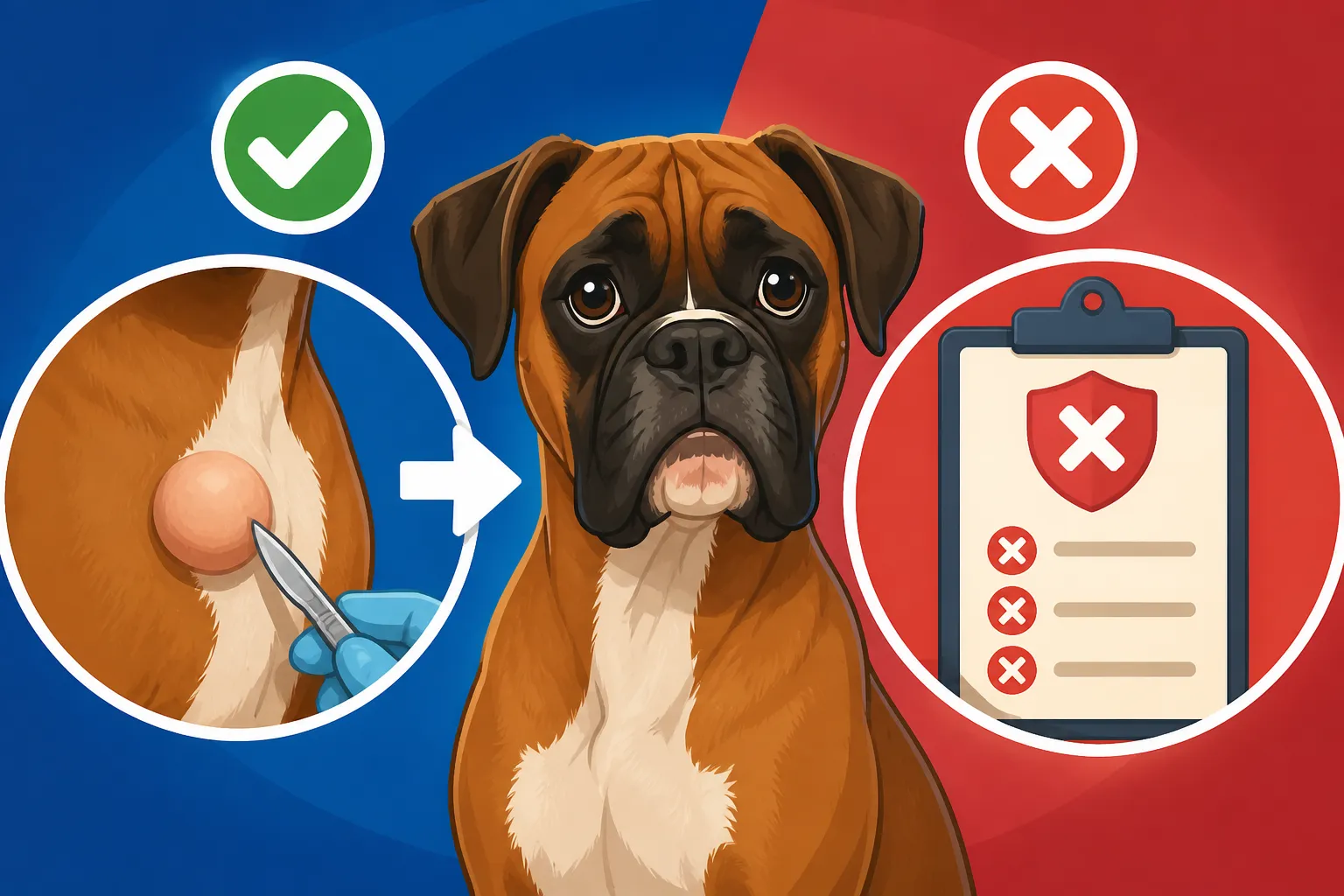
Why a Removed Boxer Lump Becomes Pre-Existing
Finding a lump on your beloved Boxer is enough to send any dog parent into a tailspin. You rush to the vet, hold your breath through diagnostics, and breathe a sigh of relief when it's benign and removed. But then, the next time a new bump appears, or even a similar issue crops up, your pet insurance company delivers the crushing news: it's a "pre-existing condition." This guide will meticulously break down why a previously removed lump, even a harmless one, can permanently impact your Boxer's insurance coverage, leaving you to face future costs alone.
Understanding the "Pre-Existing Condition" Clause in Pet Insurance
The term "pre-existing condition" is the bane of many pet owners' existence, and for good reason. It’s a clause in nearly every pet insurance policy that can feel incredibly unfair, especially when you’re doing everything right for your furry family member. But to navigate it, you first need to truly understand what it means and how it's applied, particularly when it comes to the common occurrence of lumps and bumps on our Boxers.
What Constitutes a Pre-Existing Condition?
At its core, a pre-existing condition is any illness, injury, or symptom that your pet showed before your insurance policy's effective date or the end of its waiting periods. This is crucial: it’s not just about a formal diagnosis from a veterinarian. Insurance companies are incredibly comprehensive in their definition. If your vet notes "small lump noted on flank, monitoring" in your Boxer's chart, even if no further action was taken and it seemed to disappear, that lump has now been "observed" or "manifested" as a symptom. Should a similar lump appear later, or the original one return, the insurance company can, and often will, deny coverage by labeling it pre-existing.
Think of it this way: your Boxer might have a tiny wart on their paw that you casually mention to the vet during a routine check-up. The vet says it's likely nothing, but it goes in the chart. Months later, it grows, or another similar growth appears nearby, and requires removal. The insurance company can look back at that initial mention and say, "Ah, this condition existed before you enrolled or before your waiting period ended, even if it wasn't formally diagnosed as needing treatment at the time." This can feel incredibly frustrating because, as responsible owners, we want to report everything to our vets, but doing so without insurance in place can inadvertently create an exclusion.
The Look-Back Period and Its Impact
Most pet insurance policies come with a "look-back period." This is a specified timeframe, usually anywhere from 6 to 12 months (or sometimes even longer), that the insurer will review your pet's veterinary records before your policy's start date and any applicable waiting periods. If any sign, symptom, or diagnosis of a condition appears within this look-back period, it's considered pre-existing and won't be covered.
Let's imagine you adopted a two-year-old Boxer named Duke. You sign him up for pet insurance, maybe with a reputable provider like Healthy Paws, hoping to cover his future health needs. Their policy has a 12-month look-back period. If, nine months before you enrolled Duke, his previous owner took him to the vet for a "cough," and then six months after your policy starts, Duke develops bronchitis, the insurer could potentially deny the claim. They'd refer to that previous "cough" within the look-back period as evidence of a pre-existing respiratory condition, even if the initial cough was mild and never diagnosed as anything serious.
For Boxer owners, this is particularly relevant because our breed is prone to so many different health issues. A simple skin irritation or a small growth that seems innocuous can, in the eyes of an insurance company, be the precursor to a more serious, costly condition later on. This meticulous review of past records means that even conditions that were never formally treated, or even deemed significant at the time, can come back to haunt your policy if they pop up in the look-back window. It’s why the best time to insure a Boxer is when they are a healthy puppy, ideally at eight weeks old, before any medical history accumulates that could be flagged.
Why Boxer Lumps Are a Special Case for Insurance
Boxers are notoriously prone to developing various lumps and bumps throughout their lives. It's a hallmark of the breed, almost as much as their goofy personalities and boundless energy. This genetic predisposition, while endearing in some ways (who hasn't checked out a "new" lump only to realize it's just a fatty roll?), presents a unique challenge when it comes to pet insurance and the dreaded pre-existing condition clause.
Boxers and Their Propensity for Lumps and Bumps
If you've owned a Boxer for more than a minute, you're probably intimately familiar with the weekly lump checks on a Boxer. One day, you're petting your dog, and bam—there's a new bump where there wasn't one yesterday. Boxers develop all sorts of growths, from the completely harmless to the genuinely concerning. It's just part of their genetic makeup. We often see:
- Lipomas: These are benign fatty tumors, soft to the touch, and usually movable under the skin. They are extremely common in older Boxers. While usually not a threat, they can grow quite large and sometimes interfere with movement or become irritated.
- Histiocytomas: Often called "button tumors," these benign skin tumors are common in young Boxers, typically under two years of age. They can appear suddenly, grow rapidly, and often resolve on their own within a few months.
- Warts (Papillomas): These small, cauliflower-like growths are caused by a virus and are common in puppies or dogs with compromised immune systems. They usually disappear on their own.
- Sebaceous Cysts: These occur when a sebaceous gland gets blocked, creating a sac filled with oily or cheesy material. They can rupture and become infected.
- Mast Cell Tumors: Now, this is where things get serious. Mast cell tumors are one of the most common types of skin cancer in Boxers. They can look like anything from a benign fatty lump to an angry red sore. The scary part is that even low-grade mast cell tumors can be aggressive, and Boxers are particularly susceptible to them.
The sheer variety and frequency of these growths mean that a Boxer's veterinary record will likely contain numerous mentions of "lump noted," "skin tag observed," or "growth monitored." Each one of these entries, no matter how innocent, has the potential to become a pre-existing condition if a similar issue arises later and you're trying to claim it on your insurance. Understanding the difference between telling a Boxer fatty lump from a tumor is vital for owners, but from an insurance perspective, the initial observation of any lump is often enough to trigger the pre-existing clause.
The Insidious Nature of "Undiagnosed" Conditions
Here’s where the insurance company’s perspective truly diverges from an owner’s common sense. For them, the presence of a lump, even if it's never formally diagnosed or treated at that initial vet visit, is enough to mark it as a pre-existing condition. It doesn’t matter if the vet just said, "Let's keep an eye on it," or if it was clearly benign at the time. The mere mention of it in the medical record is usually sufficient.
Let's say your Boxer, Bella, had a small, soft lump on her chest when you first got her. Your vet checked it out, suspected it was a benign fatty lump (a lipoma), and advised monitoring it. It stayed small, never bothered her, and you eventually forgot about it. Years later, at age eight, Bella develops a much larger, firmer lump on her side. This new lump is biopsied and turns out to be a mast cell tumor, one of the cancers that take most Boxers. When you submit the claim, the insurance company reviews Bella’s old records and sees that initial mention of a "lump on chest, likely lipoma." Even though the two lumps are in different locations, possibly different types, and years apart, the insurer might argue that the propensity to develop any lump or tumor is now a pre-existing condition. They could claim that the initial lipoma indicated a predisposition, thereby rendering any future growths, especially cancerous ones, pre-existing.
This is the insidious part: the "undiagnosed" or "minor" conditions can be just as problematic as the major ones. The policy isn't just about covering the specific lump that was removed; it's about covering new occurrences of that type of condition, or even a broader category of conditions like "neoplasia" (abnormal growth of tissue) if cancer was involved. It puts Boxer owners in a tough spot, as we're constantly on the lookout for new growths, and every mention in a vet chart becomes a potential future exclusion.
The Insurance Journey: Before, During, and After a Lump
Navigating pet insurance around a Boxer's propensity for lumps can feel like walking a tightrope. The timing of your policy, the thoroughness of your vet's notes, and the outcome of any lump removal all play a critical role in how future claims will be handled. Understanding this journey can help you make more informed decisions, even if it won't entirely eliminate the frustrations.
The Golden Window: Insuring Your Boxer Young
The single most impactful action you can take to protect your Boxer against the pre-existing condition clause is to get pet insurance as early as possible. Seriously, I cannot stress this enough. The "golden window" for pet insurance is when your Boxer is a healthy puppy, ideally around eight weeks old, before they've had any significant veterinary history.
Imagine two Boxer puppies, Rosie and Buster. Rosie's owner enrolled her in a comprehensive pet insurance plan, say with Healthy Paws, at 10 weeks old. Buster's owner decided to wait until he was a year old, thinking he was still young and healthy. At six months, Rosie developed a tiny, harmless histiocytoma that resolved on its own. It was noted in her vet chart. Since her insurance was already in place and her waiting periods were satisfied, any future skin issues or lumps would likely be covered, assuming they weren't directly related to that specific, now-resolved histiocytoma.
Buster, on the other hand, developed his first lump, a small but concerning growth, at nine months old. His owner then rushed to get him insured. Because that lump appeared before the policy was active and before waiting periods, it's now a pre-existing condition. Any future lumps, especially if they are similar, will likely be excluded from coverage. This is why insuring a Boxer puppy at eight weeks is so vital. It’s about getting ahead of the inevitable. Boxers live an average of ten to twelve years, and a lot can happen in that time.
The Vet Visit: Documentation is Everything
Every time your Boxer visits the vet, what gets written in those medical records becomes a permanent part of their history. For pet insurance purposes, these notes are meticulously scrutinized. This isn't to say you should ever withhold information from your vet—that would be detrimental to your dog's health—but rather, it’s about understanding the implications.
If you bring your Boxer in for a routine vaccination, and you casually mention, "Oh, I noticed a little bump on his elbow, but it doesn't seem to bother him," your vet will likely document that. Even if they assess it as a benign fatty lump or a harmless skin tag, the mention is there. If, two years down the line, that specific lump needs removal, or a similar one appears, the insurer will trace it back to that initial note. This documentation proves the condition existed before your claim.
This level of detail means that every observation, every "area of concern" noted by your vet, can become a potential pre-existing exclusion. It's not about what you know to be serious, but what is recorded. This highlights the importance of open communication with your vet about your insurance policy and its implications, so you can understand what is being recorded and how it might impact future coverage.
The "Removed" Lump and Its Aftermath
So, you've gone through the stress, had the lump removed, and perhaps the biopsy results came back clear. Relief! But what happens next from an insurance perspective? The "removed" lump doesn't simply disappear from your Boxer's history. It becomes a permanent marker, and its implications depend heavily on the nature of the lump itself.
- If the lump was benign (e.g., a lipoma, histiocytoma, wart): If it was removed before you had insurance or during a waiting period, it's considered a pre-existing condition. While that specific lump is gone, any future similar lumps could be excluded. For instance, if your Boxer had a lipoma removed from their leg, and a year later develops another lipoma on their chest, the insurer might deem the "tendency to form lipomas" as pre-existing, and deny coverage for the new one. This is what a removed lump does to a Boxer policy. Some insurers may cover new, unrelated benign growths after a certain symptom-free period, but it's not guaranteed.
- If the lump was malignant (e.g., a mast cell tumor, lymphoma): This is a much graver situation for insurance purposes. If your Boxer had a cancerous lump removed before their policy was active, then any future recurrence of that cancer, or even the development of a different type of cancer, could be deemed pre-existing. This is because cancer is often considered a systemic disease. Once a Boxer has had one type of cancer, many insurers will consider all future cancers as related or a manifestation of a pre-existing "cancer disposition." This means that even if a new tumor appears in a completely different location, or is a different grade, it might be excluded.
For example, if your Boxer, Rocky, had a mast cell tumor removed from his paw at age four, before you got insurance. Then, at age seven, he develops lymphoma, a type of cancer that affects the lymphatic system. Even though it's a different type of cancer, some insurers might view "cancer" as a general pre-existing condition and deny coverage for chemotherapy for a Boxer with cancer or other treatments for lymphoma. This can be devastating, highlighting why getting insurance before any health crises hit is paramount.
Navigating the Pre-Existing Condition Exclusion
Dealing with a pre-existing condition exclusion can be incredibly frustrating and disheartening. It feels like a betrayal, especially when you've done your best to care for your Boxer. While the rules are often clear-cut from the insurer's perspective, there are nuances and actions you can take to understand, and in rare cases, challenge these decisions.
Related Conditions and Systemic Issues
This is where the pre-existing condition clause gets particularly thorny for Boxer owners, especially concerning cancer. Insurance companies often don't just exclude the exact condition that manifested prior to coverage; they can exclude "related" conditions or classify broader "systemic issues" as pre-existing.
For instance, if your Boxer, Daisy, had a benign skin tumor (like a histiocytoma) removed from her ear before her insurance policy began, then a year later develops a mast cell tumor on her leg. An insurer might argue that the initial benign tumor demonstrated a general "propensity for skin masses" or "neoplasia" (abnormal cell growth), and therefore the mast cell tumor is a related, pre-existing condition. This is especially true if the initial lump was never formally diagnosed by biopsy, making it harder to prove it was truly unrelated.
The challenge is magnified when cancer is involved. Boxers are highly prone to various cancers, including mast cell tumors, lymphoma, and brain tumors in Boxers. If your Boxer has one cancer diagnosis on record before insurance, many policies will consider any future cancer a pre-existing condition, even if it's a different type or in a different location. The logic is that the dog has a pre-existing "cancer disposition," or that all cancers are systemic manifestations of an underlying issue. This means that whether any insurer excludes Boxer cancer, it's often a policy-specific interpretation, but the general trend is towards broad exclusions if a cancer diagnosis predates the policy. This broad brush approach can be financially devastating for owners, as cancer treatments can run into the tens of thousands of dollars.
Appeals and Advocacy: Is There Any Hope?
While pet insurance companies adhere strictly to their policy terms, it's not entirely hopeless if a claim is denied due to a pre-existing condition. You do have the right to appeal their decision. This process requires thoroughness, patience, and strong advocacy for your Boxer.
Here’s what typically happens and what you can do:
- Review the Denial Letter: The insurance company is required to provide a reason for the denial. Understand exactly why they denied it and which specific policy clause they are citing.
- Gather All Documentation: This means collecting every single veterinary record pertaining to your Boxer’s health, especially records from before your policy started and leading up to the denied claim. Look for anything that could support your case that the condition is not pre-existing or that the current condition is completely unrelated to anything previously noted.
- Get a Vet's Statement: Ask your veterinarian to write a letter or statement clarifying the situation. For example, if the denied claim is for a new lump, and the previous lump was definitively diagnosed as a completely benign, self-resolving histiocytoma in a young dog, your vet might be able to argue that there's no medical link to a new, malignant tumor in an older dog. Their medical opinion carries weight.
- Submit a Formal Appeal: Follow the insurer's specific appeals process. This usually involves submitting a written letter outlining why you believe their decision is incorrect, supported by all relevant veterinary records and your vet’s statement.
- Be Persistent: Sometimes, it takes multiple attempts. If your initial appeal is denied, ask if there’s a higher level of review or an ombudsman. Some policies might have a clause where a "curable" condition can become eligible for coverage after a certain period (e.g., 6-12 months) without symptoms or treatment. This is rare for chronic or cancerous conditions but worth investigating.
While successful appeals are not guaranteed, especially with complex issues like cancer predisposition, the effort is worthwhile. It's about presenting a clear, medically supported argument that challenges the insurer's interpretation of your Boxer's history.
Strategies to Mitigate Financial Risk for Boxer Owners
Even with the best pet insurance, the reality of pre-existing conditions, especially for a breed like the Boxer, means that some costs might still fall on your shoulders. It's crucial for Boxer owners to have a multi-faceted strategy to manage potential financial burdens.
Embrace Wellness Plans and Accident-Only Coverage (with caution)
While these options won't address pre-existing lump issues directly, they can provide a safety net for other aspects of your Boxer's health and free up funds that you might otherwise spend on routine care.
- Wellness Plans: Many pet insurance providers, or even veterinary clinics directly, offer wellness plans. These aren't insurance in the traditional sense but rather discount packages or prepaid programs for routine care like annual exams, vaccinations, heartworm tests, and even dental cleanings. Companies like Chewy, through their pet insurance partners, might offer wellness add-ons. By covering these predictable costs, you can save your out-of-pocket funds for the unexpected, especially those potential pre-existing conditions.
- Accident-Only Coverage: This type of policy is typically much cheaper than comprehensive plans because it only covers injuries resulting from accidents (e.g., being hit by a car, broken bones, ingestion of a foreign object). It explicitly excludes illnesses, including all types of lumps and diseases. While it doesn't help with cancer, it does protect against expensive emergency vet bills from unforeseen accidents, allowing you to keep a separate fund for illness-related issues. This can be a viable option for a Boxer with known pre-existing conditions that would otherwise make comprehensive coverage prohibitively expensive or largely useless for illness.
It's vital to read the fine print with both wellness plans and accident-only policies. Make sure you understand exactly what is covered and what isn't. Don't assume anything. These are complementary tools, not replacements for a robust health strategy.
The Power of a Dedicated "Boxer Fund"
Given the Boxer's predisposition to various health issues, including the unfortunate reality of cancer, one of the most proactive and responsible financial steps any Boxer owner can take is to create a dedicated "Boxer Fund." This is essentially self-insurance, saving money specifically for potential vet bills that either insurance won't cover or for which you simply don't have insurance.
Think of it as your Boxer's own savings account. Start contributing regularly, even if it's a small amount each month, from the moment you bring your puppy home. The goal is to build up a substantial reserve that can cover unexpected, potentially costly treatments, especially those related to pre-existing conditions or conditions that appear after your policy is too late.
Consider the potential costs you might face:
- Lump Removal & Biopsy: A simple lump removal can range from a few hundred to over a thousand dollars, depending on size, location, and the need for sedation or general anesthesia. Histopathology fees on a Boxer tumor for grading add another couple of hundred.
- Cancer Treatment: This is where costs can truly skyrocket. Chemotherapy for a Boxer with cancer can involve multiple sessions over months, potentially costing thousands of dollars (e.g., $3,000-$10,000+). Radiation therapy prices for a Boxer are even higher. And this doesn't even include the initial diagnostic costs like advanced imaging (CT, MRI) which can be several thousand dollars alone.
- Chronic Conditions: Even non-cancerous pre-existing conditions, like a recurring Boxer colitis or managing Boxer cardiomyopathy and the Holter monitor screenings, can incur ongoing medication and specialist consultation fees.
By having a Boxer Fund, you empower yourself to make treatment decisions based on what’s best for your dog, rather than being limited by your budget or insurance exclusions. This is particularly relevant as your Boxer ages and the likelihood of health issues increases. The cancer fund a Boxer owner should build is not just a good idea; it's a critical component of responsible Boxer ownership, providing peace of mind and genuine financial security for your beloved companion.
Disclaimer
This article is for general informational purposes only and does not constitute professional advice. Laws, prices and regulations vary by location and change over time. Consult a qualified professional for guidance on your specific situation.