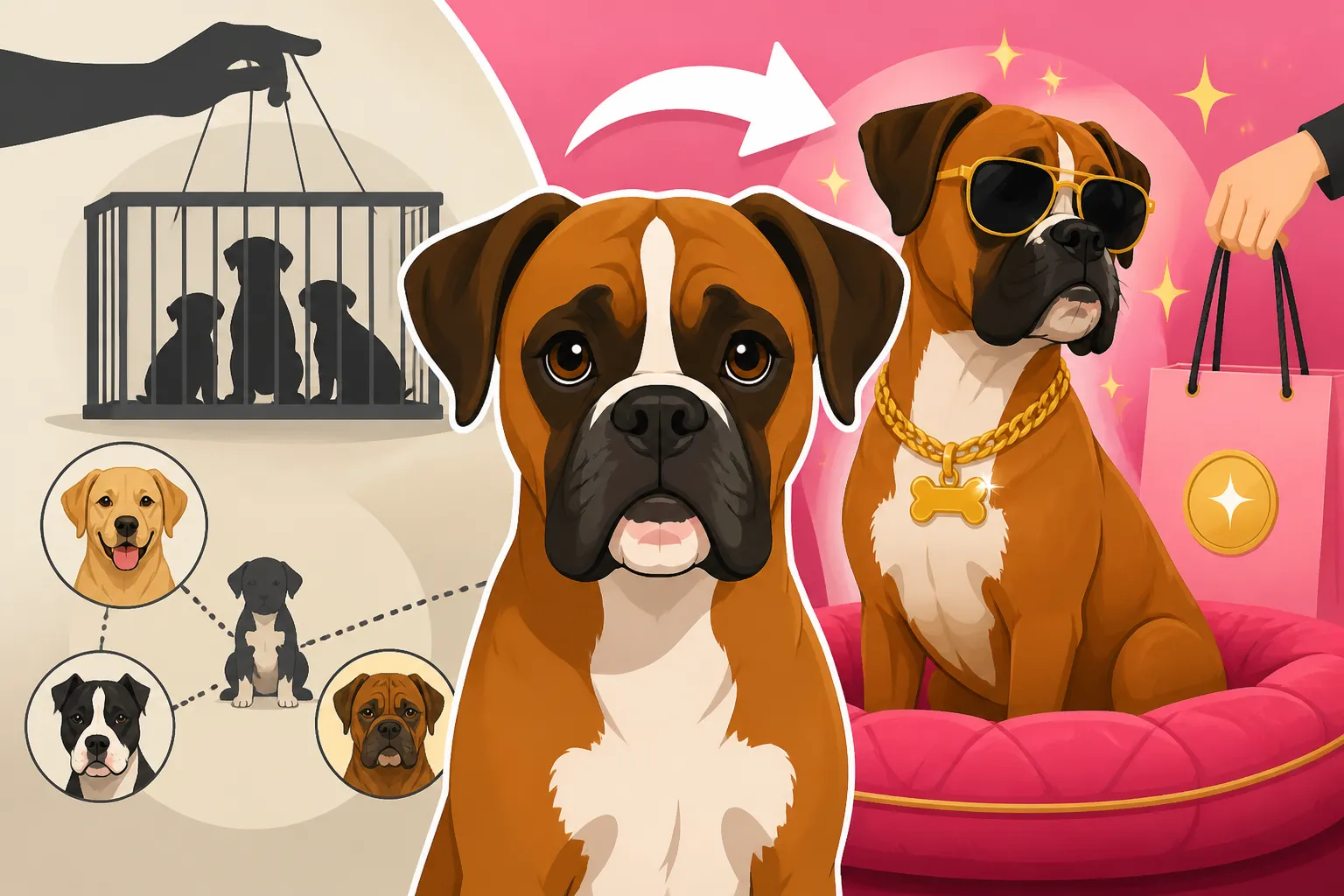
Boxer Crosses Sold as Designer Dogs
A “Boxador” listing can sound like a predictable blend: a Boxer’s friendliness, another breed’s coat, and a size you can plan around. In real life, a crossbred puppy may inherit any mix of traits, and a designer name does not guarantee health, temperament, or appearance. This guide explains what Boxer crosses can be like, how to assess a breeder or rescue listing, and what to ask before bringing one home.
What a Boxer cross actually means
Designer names do not describe a consistent type
Names such as Boxador, Boxweiler, and Boxsky are informal labels for dogs with a Boxer parent and another breed somewhere in their ancestry. They can help people describe a cross, but they are not official breed standards. There is no single agreed appearance, temperament, or adult size attached to a name like “Boxador.”
Even puppies in the same litter can differ substantially. One might inherit a Boxer’s short coat and broad head, while a sibling has a coat or body shape more like the other parent. Energy level, sociability, prey drive, and tolerance for being alone can vary too. A label cannot tell you which traits a particular puppy will inherit.
That uncertainty matters when an advert promises a very specific outcome, such as a “low-shedding Boxer” or a “calm, apartment-sized Boxer mix.” Coat type, adult size, and temperament are affected by inherited traits and environment; crossing two breeds is not a reliable way to order a particular combination. A responsible seller should talk about possibilities and limits rather than presenting a designer name as a guarantee.
The other parent matters as much as the Boxer
When you are considering a Boxer cross, learn the identity of both parents and understand what each breed may contribute. A Boxer’s physicality and enthusiasm may combine with another breed’s guarding instincts, herding tendencies, independence, or exercise needs. Those are possibilities, not certainties, but they are useful questions to raise before choosing a puppy.
For example, a cross with a large, powerful breed may grow into a dog that is difficult to manage on leash if early training is inconsistent. A cross with a high-energy working breed may need more daily activity and purposeful training than a casual walk around the block. A cross with a smaller or more delicate breed could have a different build from what the listing photo suggests. Ask about the actual parents’ size, behavior, and health rather than relying on breed-name assumptions.
Understanding the Boxer’s own background helps make those questions more practical. Which Breeds Were Crossed to Make the Boxer offers context on the breed’s origins, while Boxer Temperament in the Standard and in Life is useful for thinking beyond a short description such as “playful” or “protective.” A cross may resemble its Boxer parent in some ways without reliably inheriting every familiar Boxer trait.
Health and temperament are not guaranteed by a cross
A mixed-breed dog still needs careful health screening
People sometimes assume that crossing breeds automatically prevents inherited health problems. It does not. A crossbred dog may inherit health risks associated with either parent breed, and some conditions can occur in dogs with mixed ancestry. The puppy’s risk depends on its family lines and other factors—not simply on whether its parents are different breeds.
Ask for the health history and screening records relevant to both parent breeds. A responsible breeder should be able to explain which tests were appropriate, what the results mean, and whether the dogs have a family history of significant medical problems. “The parents are healthy” is not a substitute for records or a clear explanation. If the seller cannot identify the other parent’s breed or provide meaningful health information, you have less basis for judging what the puppy may face.
Boxers have their own health considerations, and combining a Boxer with another breed does not erase them. Whether a Boxer Mix Escapes the Cancer Risk explains why “mixed” is not a guarantee of protection. For broader guidance on what health information to request, see The Health Screening a Boxer Breeder Owes You and What a Serious Boxer Breeder Does Differently. The specific screening needed depends on the other parent as well, so ask your veterinarian or a qualified breed-health professional how to interpret the records for that particular cross.
Temperament depends on more than a breed label
A dog’s behavior develops through a combination of inherited tendencies, early care, social experiences, health, and training. A Boxer cross might be outgoing and people-oriented, but that should not be treated as a promise. The puppy could be more reserved, easily startled, intensely energetic, or strongly motivated to chase moving objects. Even littermates raised together can develop different preferences and coping styles.
Ask the breeder or rescue what they have actually observed. Does the puppy recover after a sudden noise? How does it respond to handling, new people, and a brief separation from its litter? Does it settle after play, or keep escalating? These observations do not predict an adult dog with certainty, but they offer more useful information than a claim that the puppy is “perfect for every family.”
Think honestly about your own household, too. A powerful, bouncy adolescent dog may be hard to manage around small children or anyone who could be knocked over. A dog that needs frequent activity and companionship may struggle if left alone for long stretches. The Household a Boxer Actually Needs and What a First Boxer Demands of a New Owner can help you assess whether the Boxer side of the mix fits your daily routine. Do not assume a cross will automatically be easier, quieter, or less demanding than a purebred Boxer.
How to assess a Boxer cross listing
Ask questions that reveal how the dog was bred or raised
A good conversation should leave you with clear information, not just appealing photos and a deposit request. Ask who bred the litter, where the puppy has been raised, whether you can meet the mother, and what is known about the father. If one parent is unavailable, ask why and what documentation verifies the dog’s identity and health background.
Ask for the parents’ health records and a written explanation of relevant screening. Find out what veterinary care the puppies have received, how their age and health are documented, and what support is available after they go home. A conscientious breeder should be willing to discuss the drawbacks of the cross as well as its attractions. They should also ask about your experience, schedule, housing, and plans for training, because a puppy’s needs do not disappear once the sale is complete.
Be wary of pressure to decide immediately, vague answers about parentage, or claims that the cross is guaranteed hypoallergenic, healthier, non-shedding, or unusually easy to train. A refusal to let you see where the puppies are raised is another reason to slow down and ask more questions. A legitimate explanation should be specific and consistent—not a string of reassuring slogans.
Compare breeder and rescue options carefully
A Boxer cross may come from a breeder, a shelter, or a breed-specific rescue that accepts mixes. Each route has different uncertainties. With a puppy, you may have more access to parent information but less certainty about adult behavior and size. With an adult rescue dog, the history may be incomplete, but staff or foster carers may have already observed how the dog behaves in a home.
| What you are assessing | Questions to ask | Why it matters |
|---|---|---|
| Parentage | What breeds are the parents, and can I meet the mother? | Helps you understand possible size, traits, and family history |
| Health | What screening and veterinary records are available? | Gives you a basis for discussing risks and care with your veterinarian |
| Temperament | What has been observed around people, handling, and other animals? | Offers more useful clues than a designer label alone |
| Early environment | Where was the puppy raised, and what experiences has it had? | Helps you understand its social exposure and current needs |
| Adult dog history | What is known about behavior, medical care, and prior homes? | Can make planning easier, while still leaving room for adjustment |
| Seller or rescue support | What happens if the placement is not a good fit? | Clarifies responsibilities and support after the dog comes home |
Regardless of where you adopt or buy, plan for the possibility that the dog’s needs will differ from the advert. A safe harness, secure identification, appropriate bedding, food, and a place to rest are practical first steps. Some new owners use retailers such as Chewy to organize basic supplies, but the right equipment depends on the individual dog’s size and behavior; check fit and suitability rather than buying to match a breed nickname. A local veterinarian can help you set up an initial health visit and decide what records or follow-up care are needed.
Preparing for life with a Boxer cross
Plan for training, exercise, and changing needs
A young Boxer cross can be exuberant, strong, and easily distracted. Start with simple household routines: reward calm greetings, practice coming when called in safe settings, teach the dog to settle on a bed, and use short training sessions that end before attention fades. Do not wait until a large adolescent is pulling hard or jumping on visitors to begin teaching manners. For practical ideas about common Boxer behavior, Stopping a Seventy-Pound Boxer From Jumping is relevant even if your dog is a mix.
Exercise should match the individual dog’s age, fitness, build, and health—not just the expectations attached to a designer name. A puppy needs appropriate opportunities to explore and play, with care not to push it into strenuous activity. An adult may enjoy longer walks, scent games, or training activities, but heat and breathing comfort deserve particular attention if the dog has a short muzzle or struggles to cool itself. Ask your veterinarian how to adjust activity to your dog’s condition and development.
It also helps to prepare for ordinary, unglamorous needs: house-training accidents, chewing, vet appointments, nail trims, and the time it takes to teach a dog to be comfortable alone. If you are new to this type of active, people-focused dog, Whether a Boxer Fits a First-Time Owner can help you think through the commitment. The best plan is flexible. Watch the dog in front of you, reward behavior you want to see again, and seek qualified help early if fear, reactivity, or handling problems appear.
Make your decision around the individual dog
Before committing, write down what your household can realistically offer: daily companionship, exercise, training, veterinary care, and a safe setup. Then compare that with what is known about the dog—not just the advertised mix. Ask yourself whether you can manage a large, strong adult if the puppy grows bigger than expected, and whether you can adapt if its coat, energy, or temperament differs from your hopes.
For an adult rescue, ask about behavior in a foster home, comfort with children or other pets, and any known medical or training needs. A shelter assessment is helpful but not a guarantee of how a dog will behave in a new home. Plan a gradual introduction to household routines, give the dog a quiet retreat, and avoid forcing interactions while it settles.
For a puppy, be prepared to guide its development for years rather than expecting a quick transformation. Use reward-based training, arrange safe and positive experiences, and keep veterinary care consistent. You may find that practical supplies from Chewy or a local pet shop are useful as the dog grows, but the most important preparation is time and a realistic understanding of uncertainty. A thoughtfully chosen Boxer cross can be a wonderful companion; the safest choice is the dog whose needs you can meet, not the designer name that sounds most appealing.
Disclaimer
This article is for general informational purposes only and does not constitute professional advice. Laws, prices and regulations vary by location and change over time. Consult a qualified professional for guidance on your specific situation.