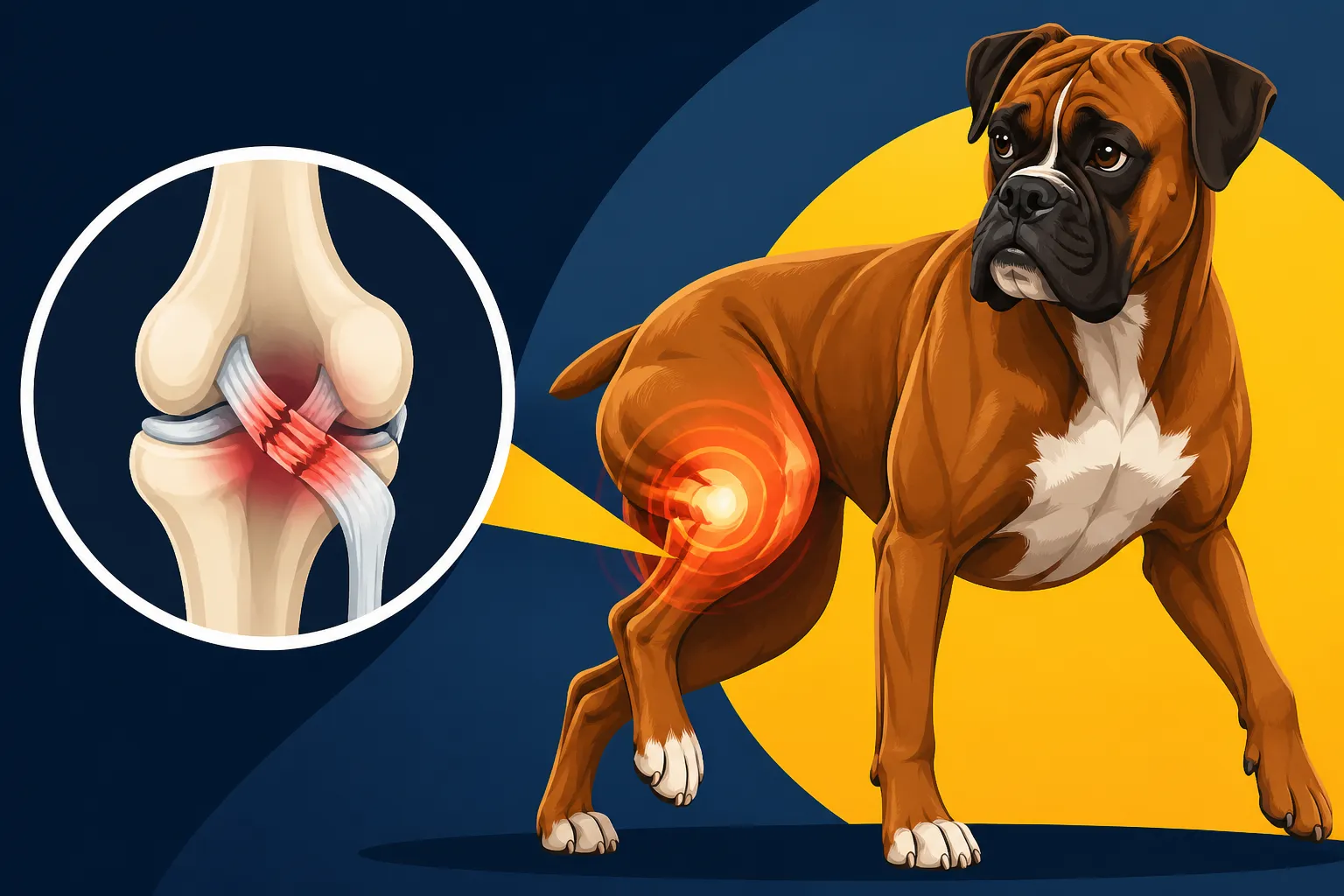
Cruciate Tears in a Muscular Boxer
It’s a heartbreaking sight for any Boxer owner: one moment your magnificent, athletic dog is zooming across the yard, full of life and joy, and the next, they’re holding a back leg up, wincing, or struggling to bear weight. The sudden onset of lameness can send a wave of panic through you, especially when you know how much your Boxer loves to move and play. For our muscular, high-energy Boxers, a common and often debilitating injury is a tear of the cranial cruciate ligament, an issue that demands immediate attention and a clear path forward. This comprehensive guide will walk you through understanding cruciate tears, recognizing the signs, exploring treatment options, and navigating the recovery process so you can help your beloved Boxer get back on their feet.
Unpacking the Cruciate Ligament and Why Boxers Face Trouble
The knee joint in dogs, much like in humans, is a complex hinge designed for powerful movement. When something goes wrong in such a crucial joint, it impacts every aspect of a dog's life. Understanding the mechanics is the first step to truly grasping the nature of a cruciate tear.
The Anatomy of a Crucial Knee Support
Inside your Boxer's knee, or stifle, you'll find two strong ligaments that cross over each other, forming an "X." These are the cranial cruciate ligament (CrCL) and the caudal cruciate ligament. While both are vital, it's the cranial cruciate ligament that most commonly suffers damage in dogs. This ligament acts like a strong rope, preventing the tibia (shin bone) from sliding forward excessively relative to the femur (thigh bone) and also helps to limit internal rotation of the joint.
Think of it as the main stabilizer that keeps the knee from twisting or overextending. Without a healthy cranial cruciate ligament, the knee becomes unstable, allowing the bones to shift abnormally with every step. This instability isn't just uncomfortable; it causes pain, inflammation, and progressive damage to the joint over time, leading to significant arthritis if left untreated.
Why Our Athletic Boxers Are Susceptible to Tears
Boxers are renowned for their powerful, athletic builds and boundless energy. They love to run, jump, twist, and "box" with their front paws, often engaging in high-impact play. Unfortunately, this very athleticism, combined with certain breed predispositions, makes them particularly vulnerable to cruciate ligament injuries. Unlike a sudden, traumatic ACL tear often seen in human athletes, a Boxer's cruciate ligament often weakens over time due, in part, to chronic degeneration.
This degeneration means the ligament slowly frays and loses its elasticity, becoming more susceptible to tearing, sometimes with minimal provocation. A seemingly innocuous twist during play or a misstep off the couch can be enough to cause a partial or complete tear in an already compromised ligament. Their natural conformation, specifically the angle of their tibial plateau, is also thought to contribute to the strain on the ligament, making them a breed that vets frequently see with this issue. It's not just a freak accident; for many Boxers, it's a ticking time bomb influenced by their genetics, weight, and activity levels.
Spotting the Signs: When Your Boxer's Leg Isn't Right
Recognizing a cruciate tear early is crucial for the best possible outcome. However, the signs aren't always as dramatic as you might expect, and they can vary depending on whether the tear is sudden and complete or a more gradual, partial rupture.
The Sudden Limp Versus a Lingering Lameness
Sometimes, a cruciate tear is unmistakable. Your Boxer might be playing fetch, make a sharp turn, let out a yelp, and then suddenly become severely lame, holding the affected leg up completely or just "toe-touching." This acute, sudden lameness often indicates a complete tear of the ligament. It's a shocking moment for any owner, seeing their vibrant dog instantly incapacitated. You'll know something is seriously wrong immediately.
However, many Boxer owners experience a more insidious onset. A partial cruciate tear might manifest as a subtle, intermittent lameness that seems to come and go. Perhaps your Boxer is a little stiff after exercise, or they favor one leg occasionally, but then seem fine a few hours later. This can be incredibly frustrating and confusing, as you try to pinpoint the problem. These partial tears can progress to full ruptures over weeks or months, as the damaged ligament continues to weaken. Over time, that slight limp becomes more pronounced and constant, indicating the injury is worsening.
What to Observe in Your Boxer's Movement and Behavior
Beyond the obvious limping, there are several other subtle, yet telling, signs that your Boxer might be suffering from a cruciate tear. Pay close attention to how your Boxer moves and interacts with their environment. You might notice a reluctance to engage in activities they once loved, such as jumping into the car or onto the sofa, or hesitating before using stairs. They might appear stiff when getting up from a resting position, or walk with a "stilted" gait, trying to protect the painful joint.
Watch them sit: a Boxer with a cruciate injury often won't sit squarely, instead extending the affected leg out to the side rather than tucking it underneath them, a posture often called an "abnormal sit." You might also notice a decrease in muscle mass (atrophy) in the affected thigh over time, especially if the injury has been present for a while, as they're not using that leg as much. Some Boxers might also lick or chew at their knee area due to discomfort. Being attuned to these behavioral changes is key to catching the problem early.
Getting a Diagnosis and What Happens Next
When you suspect a cruciate tear, a trip to the vet is paramount. The diagnostic process aims to confirm the tear, assess its severity, and rule out other potential causes of lameness.
The Veterinary Examination and Diagnostic Tools
Your veterinarian will perform a thorough orthopedic examination, paying close attention to the affected knee. The most definitive diagnostic tests for a cruciate tear are the "cranial drawer test" and the "tibial thrust test." During the cranial drawer test, the vet will attempt to move the tibia forward relative to the femur. If the cranial cruciate ligament is torn, there will be abnormal forward motion, much like a drawer opening. The tibial thrust test involves flexing the ankle joint to create a forward thrust of the tibia, which is then stabilized by the intact cruciate ligament. If the ligament is torn, the tibia will move abnormally forward.
In our strong, muscular Boxers, these tests sometimes require sedation to get an accurate reading, as their powerful leg muscles can inadvertently stabilize the joint, masking the instability when they're awake and tense. Your vet will also likely recommend X-rays. While X-rays don't directly show the ligament itself, they are invaluable for assessing secondary signs of joint instability, such as joint effusion (fluid buildup), early signs of osteoarthritis, and ruling out other bone or joint pathologies. It's about putting all the pieces together to get a full picture of what's going on inside that knee.
Managing the Initial Pain and Restricting Movement
Once a cruciate tear is diagnosed, the immediate focus is on managing pain and preventing further damage. Your vet will prescribe pain relievers and anti-inflammatory medications to help your Boxer feel more comfortable. This initial phase is critical but can be incredibly challenging with a high-energy Boxer. Strict activity restriction is absolutely essential. This means no running, jumping, playing, or off-leash activity. Leash walks should be short and controlled, just long enough for potty breaks, and always on a short lead to prevent sudden movements.
For a Boxer, whose default setting is often "full throttle," this confinement can be incredibly difficult, leading to frustration for both dog and owner. A secure crate or a small, confined area in the house where they can't get into mischief is vital. You might find a comfortable, chew-proof bed, like those often recommended for Crates, Beds and Gear Sized for a Boxer, to be a lifesaver during this period. While some temporary braces are available, they are generally not a long-term solution for large, active dogs like Boxers and are more often used as a palliative measure or for very specific non-surgical candidates. The goal of this initial management is to stabilize the joint as much as possible and reduce inflammation before making definitive treatment decisions.
Navigating Surgical Solutions for a Strong Recovery
For most Boxers, surgery is the recommended and most effective treatment for a torn cranial cruciate ligament. While it can be a daunting prospect, especially given the cost and recovery involved, it offers the best chance for long-term stability and quality of life.
Why Surgery is Often the Preferred Path for Active Boxers
For smaller, less active dogs, conservative management with strict rest and medication can sometimes lead to an acceptable outcome. However, for large, muscular, and inherently active breeds like Boxers, conservative management rarely provides satisfactory long-term stability. Their sheer size and power mean that without a surgically stabilized knee, the joint will remain unstable. This instability not only causes chronic pain and lameness but also rapidly leads to the development of severe osteoarthritis, which can dramatically impact their mobility and quality of life later on.
Furthermore, when one cranial cruciate ligament tears, there's a significant risk (up to 50%!) that the other one will tear within 1-2 years. This is often due to the increased strain placed on the "good" leg as it compensates for the injured one, combined with any underlying genetic predisposition to ligament degeneration. Addressing the initial tear surgically can help your Boxer regain strength and reduce the compensatory stress on the opposite limb, though it doesn't eliminate the risk entirely. For a breed known for its robust athleticism, giving them the best chance at a full, active life often means opting for surgical intervention.
Understanding the Main Surgical Techniques
When it comes to fixing a Boxer's cruciate tear, there are several surgical options, each with its own approach to stabilizing the knee. The choice often depends on the individual Boxer's size, age, activity level, and the surgeon's preference and expertise.
- Tibial Plateau Leveling Osteotomy (TPLO): This is often considered the gold standard for large, active breeds like Boxers. The surgeon makes a curved cut in the top of the tibia (the tibial plateau) and rotates it to change the angle, then stabilizes it with a bone plate and screws. The goal isn't to replace the ligament but to eliminate the "tibial thrust" that causes instability when the dog bears weight. This effectively neutralizes the forces that would normally cause the tibia to slide forward, making the knee stable without relying on a ligament. TPLO allows for rapid return to weight-bearing and excellent long-term function.
- Tibial Tuberosity Advancement (TTA): Similar in concept to TPLO, TTA also aims to neutralize tibial thrust. In this procedure, the surgeon cuts a section of the tibia (the tibial tuberosity) and moves it forward, then secures it with an implant. This changes the angle of the patellar ligament, thereby reducing the forward thrust. TTA is another highly effective technique for large dogs, and the choice between TPLO and TTA often comes down to the individual Boxer's specific knee anatomy and the surgeon's experience.
- Extracapsular Repair (Lateral Suture Stabilization): This is an older, more traditional technique, often referred to as "lateral suture." The surgeon places a strong surgical suture outside the joint, typically from the fabella (a small bone behind the femur) to a hole drilled through the tibial crest. This suture mimics the action of the cranial cruciate ligament, providing external stability until scar tissue can form around the joint to provide more long-term support. While effective for some smaller or less active dogs, it may not be as robust or durable for a very large, powerful Boxer, and recovery can sometimes be slower compared to bone-cutting procedures.
Here’s a quick comparison of the common surgical techniques:
| Surgical Technique | Principle | Ideal For | Pros | Cons |
|---|---|---|---|---|
| TPLO (Tibial Plateau Leveling Osteotomy) | Changes tibial plateau angle to neutralize forces | Large, active dogs like Boxers | Excellent long-term stability, rapid return to function, less arthritis progression | More invasive, requires specialized equipment/training, higher cost |
| TTA (Tibial Tuberosity Advancement) | Moves tibial tuberosity forward to alter patellar ligament angle | Large, active dogs like Boxers | Good long-term results, less invasive than TPLO for some, faster recovery sometimes | Also requires specialized training/equipment, higher cost, can have implant complications |
| Extracapsular Repair (Lateral Suture) | Uses external suture to stabilize joint until scar tissue forms | Smaller, less active dogs; less severe cases | Less invasive, lower cost | May not provide sufficient stability for large, active Boxers, higher re-injury rate in some cases |
Making the Right Surgical Choice and Preparing for Costs
Deciding which surgical procedure is best for your Boxer involves a detailed discussion with your veterinarian and, ideally, a board-certified veterinary surgeon. They will consider your Boxer's specific anatomy, age, weight, and your lifestyle expectations. Don't be afraid to ask questions about the surgeon's experience with each technique, their success rates, and what the post-operative care truly entails. This is a significant decision that will impact your Boxer for years to come.
The cost of cruciate surgery can be substantial, often ranging from $3,000 to $6,000 or more per knee, depending on the procedure, your geographic location, and whether it's performed by a general practitioner or a specialist. This figure typically includes the surgery itself, anesthesia, hospitalization, initial pain medications, and follow-up X-rays. This is where pet insurance can be an absolute lifesaver. Many owners realize too late the financial strain of unexpected surgeries. Companies like Healthy Paws are designed to help cover these major costs, allowing you to choose the best treatment for your Boxer without worrying solely about the price tag. Considering Insuring a Boxer Before the First Lump or injury occurs is truly one of the most proactive steps you can take as a Boxer owner.
The Essential Road to Recovery: Post-Surgery Care and Rehab
Surgery is only half the battle; the post-operative recovery period is just as, if not more, critical to a successful outcome. It demands immense dedication and patience, especially when dealing with a high-energy Boxer who might feel much better after surgery but isn't yet fully healed.
Mastering Strict Confinement for a High-Energy Dog
The most challenging aspect of recovery for many Boxer owners is enforcing strict confinement. For the first 6-8 weeks post-surgery, your Boxer must be severely restricted from all uncontrolled activity. This means no running, jumping, playing, or navigating stairs. Leash walks are limited to short, controlled bathroom breaks, always on a short leash to prevent sudden lunges or twists. For a breed that loves to greet every visitor with exuberance and often engages in energetic play, like "Why a Boxer Boxes With Its Front Paws," this can be an emotional rollercoaster for both of you.
Crate rest is often mandatory. You'll need a spacious crate where your Boxer can stand up, turn around, and lie down comfortably, equipped with supportive bedding. Boredom and frustration can lead to destructive behaviors, so providing appropriate puzzle toys and chew items (under supervision) is important. This period tests your patience, but it is non-negotiable for proper healing of the bone and soft tissues. One misstep can lead to implant failure or re-injury, sending you back to square one.
The Power of Physical Rehabilitation and Ongoing Pain Control
Once the initial healing phase is underway, typically around 2-4 weeks post-op, your vet or surgeon will likely recommend a structured physical rehabilitation program. This is where the real work begins to restore strength, range of motion, and proprioception (awareness of body position). A certified canine rehabilitation therapist can guide you through exercises such as passive range of motion, weight-shifting exercises, controlled short walks, and eventually, underwater treadmill therapy. The underwater treadmill is fantastic for Boxers, allowing them to bear weight with less impact, building muscle and improving gait.
These rehabilitation sessions are crucial not just for physical recovery but also for preventing muscle atrophy and encouraging proper weight bearing, which ultimately leads to a better long-term outcome. Along with rehab, consistent pain management remains important. Your vet will continue to prescribe anti-inflammatory drugs and potentially other pain medications as needed. Additionally, joint supplements containing glucosamine, chondroitin, and omega-3 fatty acids (like fish oil) are often recommended long-term to support joint health and slow the progression of arthritis. These ongoing costs for physical therapy and medications can add up, and again, having pet insurance like Healthy Paws can significantly ease the financial burden, covering a percentage of these crucial therapies. It’s worth understanding What Boxer Cardiomyopathy Costs a Family to appreciate how unforeseen health issues can impact your wallet, and how insurance can help.
Addressing the Risk of a Second Tear
One of the most sobering realities of a cranial cruciate ligament tear is the increased risk of the other knee tearing. Statistics suggest that anywhere from 30% to 50% of dogs who tear one cruciate ligament will tear the other within one to two years. This isn't just bad luck; it's often due to a combination of factors. The underlying degenerative process that weakened the first ligament is likely present in the second. Additionally, the "good" leg has to bear increased weight and stress as it compensates for the injured leg, especially during the initial recovery phase.
While you cannot eliminate this risk entirely, there are strategies to minimize it. Maintaining your Boxer at an ideal lean body weight is paramount; excess weight significantly increases stress on all joints. Consistent, controlled exercise and avoiding high-impact activities on slippery surfaces can help. Continuing joint supplements and adhering to any recommended physical therapy exercises for overall conditioning are also beneficial. It's a continuous management process to keep both knees as healthy as possible.
Living Life Fully After a Cruciate Injury
Successfully navigating a cruciate tear and its recovery is a marathon, not a sprint. The goal is to return your Boxer to a happy, active life, but it's important to have realistic expectations and commit to long-term management strategies.
Long-Term Strategies for Joint Health and Comfort
While surgery significantly improves knee stability, some degree of osteoarthritis is almost inevitable in a joint that has experienced such trauma. The key is to manage it proactively to ensure your Boxer remains comfortable and mobile. This involves a multi-faceted approach. Consistent, moderate exercise tailored to your Boxer's individual capabilities is essential. Instead of intense bursts of activity, think about controlled, steady walks or swimming. Always warm up your Boxer with a gentle walk before more vigorous play, and cool down afterward.
Consider ergonomic adjustments around your home. Ramps for cars or stairs can reduce impact on joints. Provide soft, supportive bedding for your Boxer to rest on, especially as they get older and may be prone to Arthritis in an Older Boxer. Many owners find that incorporating supplemental therapies like cold laser therapy, acupuncture, or even therapeutic massage can make a noticeable difference in their Boxer's comfort levels. Newer medications, such as injectables specifically designed to manage osteoarthritis pain (e.g., Librela), are also offering exciting new options for long-term comfort. Keeping your Boxer’s weight in check is also a crucial aspect, as detailed in articles like Weight Gain and Coat Loss in a Boxer.
Preventing Future Issues and Maintaining Overall Well-being
Prevention is always better than cure, even after an injury has occurred. After a cruciate repair, maintaining your Boxer's health takes on an even greater importance. Regular vet check-ups are vital to monitor joint health and address any emerging issues promptly. Your vet can assess their gait, muscle mass, and joint comfort, adjusting medications or supplements as needed. Being mindful of your Boxer's activity levels and not pushing them too hard, especially on uneven or slippery terrain, can prevent further strain. Even simple things, like ensuring good traction on indoor floors, can make a difference.
Proper nutrition, keeping your Boxer lean and well-conditioned, and continuing with appropriate joint supplements will contribute significantly to their long-term well-being. Knowing What a Boxer Costs Across Ten to Twelve Years means understanding that a significant portion of that budget often goes towards proactive and reactive health care. The peace of mind that comes from knowing you've done everything possible, including having pet insurance from a reliable provider like Healthy Paws, allows you to focus on enjoying every moment with your resilient, loving Boxer. They've been through a lot, and with your dedicated care, they can absolutely get back to living a joyful, active life, even if it looks a little different than before.
Disclaimer
This article is intended for informational purposes only and does not constitute medical advice. Always consult with a qualified veterinarian for any health concerns or before making any decisions about your Boxer's medical care.