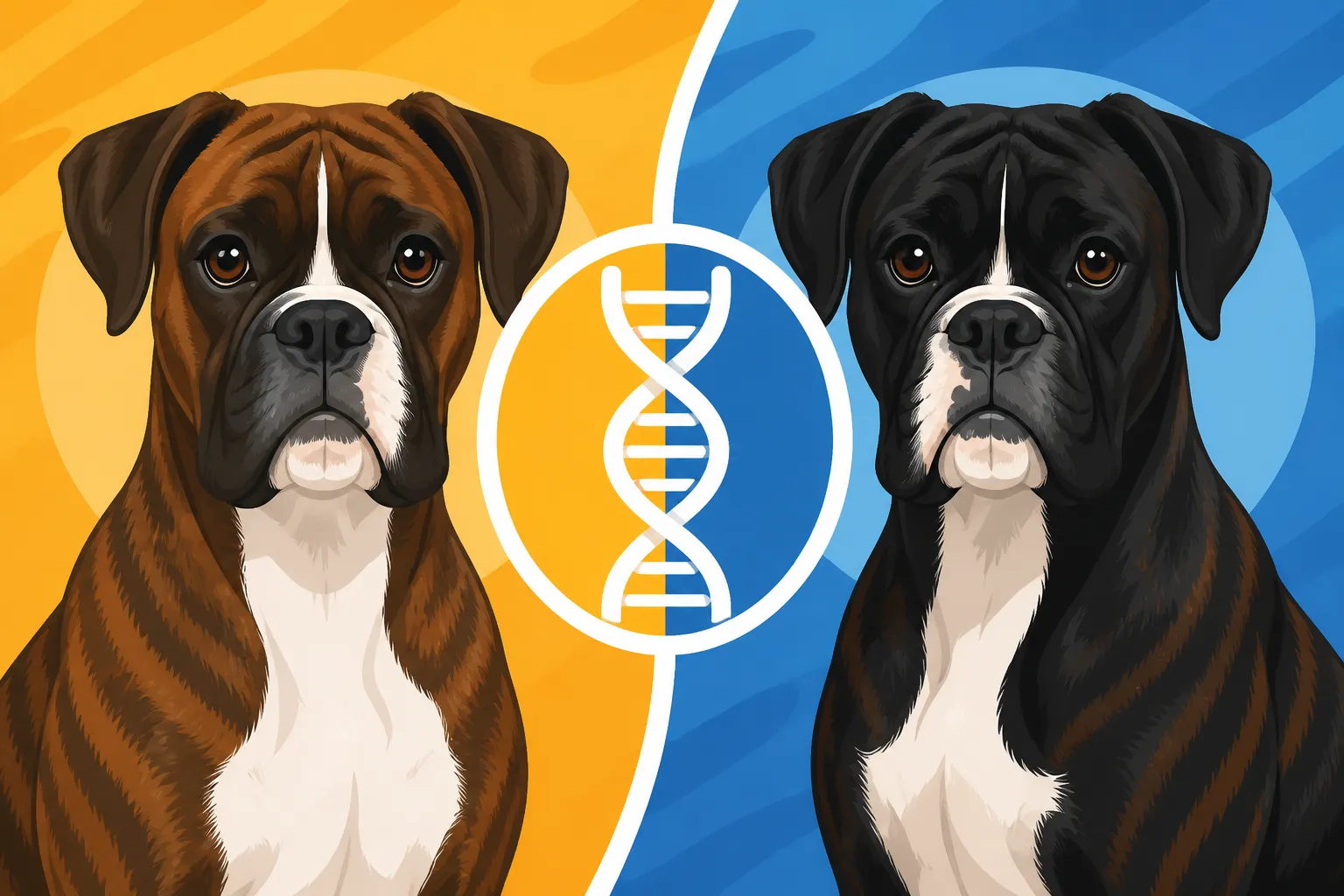
What Makes a Boxer Brindle or Reverse Brindle
It can be incredibly confusing to look at a litter of Boxer puppies, or even adult Boxers, and try to understand the subtle — or not so subtle — differences in their brindle patterns. You might see some dogs that are clearly fawn with stripes, others that look almost black, and wonder how they all fall under the "brindle" umbrella. This guide will unravel the genetics and visual characteristics that define both classic brindle and the often-misunderstood reverse brindle Boxer, helping you appreciate the stunning variety within this beloved breed's coat.
The Foundation of Boxer Coat Colors: Fawn and Brindle
Before we dive into the intricate world of brindle patterns, it’s important to understand the basic building blocks of Boxer coat colors. In essence, all Boxers are either fawn or brindle, with variations in white markings. There's no true genetic black in the Boxer breed, a common misconception often sparked by the appearance of very dark brindles.
Understanding the Fawn Base
At its heart, fawn is the underlying pigment for all Boxers that aren't pure white. Think of it as the canvas upon which other colors, like brindle stripes, are painted. Fawn itself isn't just one shade; it ranges dramatically from a very pale, almost creamy yellow to a deep, rich mahogany red. Sometimes, you'll hear people describe their fawn Boxer as "golden fawn" or "red fawn," and these are simply descriptors for the intensity of that underlying color.
This variation in fawn shades is entirely natural and contributes to the unique appearance of each Boxer. A pale fawn dog might have a coat that shimmers like spun gold in the sunlight, while a deep red fawn Boxer can appear incredibly striking, almost glowing with warmth. These differences are genetically determined, and they play a significant role in how visible the brindle stripes will be on a particular dog. Without this foundational fawn, there would be no canvas for the brindle pattern to emerge from. You can learn more about these variations in Fawn Boxers and Their Shades.
How Brindle Stripes Emerge
So, if fawn is the base, where do the stripes come from? Brindle is a pattern, not a color itself, and it's caused by a specific gene that overlays black or very dark stripes onto that fawn background. Imagine taking a fawn piece of fabric and weaving dark threads through it — that's essentially what the brindle gene does. These stripes can vary immensely in thickness, length, and density, creating a wide spectrum of visual effects.
A classic brindle Boxer will typically have clearly defined, dark stripes on a lighter fawn background. The contrast makes the pattern highly visible and gives the dog a distinctive, almost tiger-striped appearance. It’s this gene that gives Boxers one of their most iconic looks. The presence of the brindle gene is what differentiates a fawn Boxer from a brindle Boxer, turning a solid color into a dynamic, striped masterpiece.
Decoding the Brindle Pattern
When we talk about "brindle," it's not a single, uniform look. The pattern can be incredibly diverse, leading to much discussion and admiration among Boxer enthusiasts. Understanding the nuances helps appreciate why each brindle Boxer truly is unique.
The Classic Brindle Boxer
A classic brindle Boxer is what most people picture when they hear the term: a beautiful fawn dog with distinct, dark brown or black stripes running across its coat. These stripes usually follow the direction of the hair growth and can appear anywhere on the body, though they are often more pronounced on the back, sides, and legs. The beauty of a classic brindle often lies in the clear contrast between the lighter fawn and the darker stripes.
The intensity and distribution of these stripes are highly variable. You might see a Boxer with just a few sparse, thin stripes, making it appear mostly fawn with subtle streaks. On the other hand, some classic brindles have a heavier stripe pattern, with the dark markings being thicker and more numerous, creating a striking visual impact. This variation is part of the genetic lottery, making each brindle coat a unique work of art. The quality of the fawn base, whether it's a pale gold or a deep red, also influences how these stripes pop. Many owners love to see how their dog's coat changes in different lighting, highlighting the intricate patterns.
Genetic Mechanisms Behind Brindle
The brindle pattern is controlled by a specific genetic locus, often referred to as the K-locus. Without getting too deep into complex canine genetics, think of it this way: there are different "flavors" of the K-locus gene, and one of them is responsible for brindle. The Kbr allele (for brindle) causes those dark stripes to appear on a fawn background. If a Boxer inherits at least one Kbr allele, it will be brindle. If it inherits two ky alleles (non-brindle), it will be fawn. The dominant K allele (for solid black, which Boxers don't carry) would mask both fawn and brindle.
This gene dictates not only the presence of stripes but also, to some degree, their expression. The specific interaction of genes inherited from both parents determines how dense, wide, and dark these stripes become. It’s a fascinating interplay that results in the wide range of brindle patterns we observe. This is why you might see siblings from the same litter with vastly different brindle patterns, some light and some much heavier. It's a testament to the complex and beautiful genetic blueprint that creates such diverse coats. For more on this, check out Why Brindle Stripes Vary So Much on a Boxer.
Unpacking the "Reverse Brindle" Phenomenon
The term "reverse brindle" often causes a bit of confusion, and for good reason! It sounds like the stripes should be light on a dark background, but that's not quite how it works for Boxers. It's a visual trick, not a genetic reversal.
What "Reverse Brindle" Really Means
When someone talks about a "reverse brindle" Boxer, they aren't describing a dog with light stripes on a dark background. Instead, they're referring to a Boxer with an extremely heavy brindle pattern, where the dark stripes are so dense and wide that they overpower the fawn base color. The fawn actually appears as the "stripes" or streaks, visible only as thin lines or patches peeking through the dominant dark pigment. It's truly an optical illusion, where the dark areas become the background and the fawn becomes the foreground.
Imagine a heavily tattooed person where the skin is almost entirely covered by ink; the glimpses of skin are like the fawn showing through on a reverse brindle. From a distance, these Boxers can look almost entirely black, with just hints of fawn, giving them a very striking and powerful appearance. This coloration is a testament to the intensity of the brindle gene at work, pushing the boundaries of what a "striped" dog can look like. It's a common point of discussion among Boxer owners, as these dogs are incredibly unique in their presentation.
The Illusion of a Black Boxer
One of the biggest misconceptions in the Boxer world is the existence of a true black Boxer. While many "reverse brindle" Boxers appear black, especially at first glance or in certain lighting, they are genetically still brindle. The fawn pigment is always there, albeit in such minimal quantity that it's often hard to spot without close inspection. You might see faint reddish-brown hairs on their muzzle, behind their ears, or on their chest, confirming their brindle identity.
This illusion is so convincing that sometimes people will adamantly claim their Boxer is black. However, a pure black Boxer, in terms of genetics, simply doesn't exist within the breed standard. If you come across a dog advertised as a "black Boxer," it's almost certainly a very dark reverse brindle or possibly a Boxer mix with another breed. The faint fawn markings are the tell-tale sign that confirms their genetic brindle status, upholding the breed's established color patterns. This visual anomaly is what makes them so captivating and often sparks conversations, especially when you're stocking up on essentials from places like Chewy, and people comment on your dog's unique color. To delve deeper into this phenomenon, read Reverse Brindle Boxers and Why They Look Black.
White Markings and "Flashy" Boxers
Beyond the fawn and brindle patterns, white markings add another layer of complexity and beauty to the Boxer coat. These markings are incredibly common and contribute to what's known as a "flashy" Boxer.
The Role of White Markings
White markings in Boxers are caused by a separate gene, known as the S-locus (for spotting). This gene dictates where and how much white appears on the dog's coat, independent of the fawn or brindle base color. These markings can range from small patches on the chest or feet to extensive white covering the legs, chest, and often a blaze on the face. A Boxer with significant white markings, particularly on its face, neck, and chest, is often referred to as "flashy."
These white areas do not, however, alter the underlying fawn or brindle pattern; they simply mask it. So, a flashy brindle Boxer will have its brindle stripes visible in the colored areas, while the white parts will be devoid of any stripes or fawn coloring. It's like pouring white paint over parts of a canvas – the original painting is still underneath, but you can't see it in the painted-over sections. This makes for a visually striking dog, with bold patches of white contrasting beautifully with the brindle or fawn. These distinct markings are part of what makes each Boxer so individually appealing.
When White Overrides Color
In some cases, the white spotting gene can result in a Boxer that is predominantly white, often referred to as a "white Boxer." These dogs are still genetically fawn or brindle underneath all that white, but the extensive white pigmentation effectively covers up almost all of their underlying color and pattern. You might find tiny patches of fawn or brindle around their eyes, ears, or tail, which are the only hints of their true genetic color.
While beautiful, white Boxers are often associated with certain health concerns, particularly deafness. This is not because of the lack of color itself, but because the genes responsible for extensive white can also affect the development of pigment cells in the inner ear. It’s a fascinating genetic link that breeders must be mindful of. Even a white Boxer still carries the genes for either fawn or brindle, proving that these are the only two base coat patterns for the breed. Understanding How Much White a Boxer May Carry can shed more light on these fascinating variations. When you see a white Boxer, remember that beneath that snowy exterior, there’s still a fawn or brindle dog at heart.
Breeders, Standards, and Color Expectations
The Boxer breed standard is quite specific about acceptable colors and markings, influencing breeding practices and what is considered desirable in the show ring. For pet owners, understanding these standards can deepen appreciation for their dog's unique coat.
The Boxer Breed Standard on Color
According to the official breed standards, such as those upheld by the American Kennel Club (AKC) and the Deutscher Boxer Club in Germany, the only acceptable colors for Boxers are fawn and brindle. This means any shade of fawn, from light yellow to a deep mahogany, and any variation of brindle, including the heavily striped "reverse brindle," are considered permissible. However, the standard also outlines limits on white markings. While some white on the chest, feet, and face is acceptable and common in "flashy" Boxers, excessive white (typically more than one-third of the body) is generally considered a fault in the show ring. The Two Colors a Boxer Is Allowed explicitly states these guidelines.
The breed standard is incredibly detailed, even down to the desired proportions of the Boxer head, as discussed in Boxer Head Proportions in the Standard. This meticulousness ensures that breeders aim for consistency within the breed while still allowing for natural variations in coat color. The standard exists not to discriminate against certain colors, but to preserve the traditional appearance and health of the breed as it was originally developed. It's a guiding principle that shapes breeding decisions and judging criteria, ensuring that the Boxer's distinctive look is maintained for future generations.
Genetic Testing and Ethical Breeding
For fawn and brindle patterns, visual identification is usually sufficient, as the genetic expression is quite clear. However, understanding the underlying genetics is crucial for ethical breeders. While there isn't typically a "test" for how heavy a brindle pattern will be, breeders can use their knowledge of parentage and past litters to anticipate outcomes. The focus of responsible breeding always remains on health, temperament, and adherence to the overall breed standard, rather than chasing specific, rare color patterns.
Ethical breeders prioritize health screenings, such as those for cardiac issues like ARVC or hip dysplasia, over purely aesthetic traits. They strive to produce healthy, well-adjusted puppies that embody the best qualities of the Boxer breed, regardless of whether they are a light fawn, a classic brindle, or a striking reverse brindle. You can find out more about what a responsible breeder provides in The Health Screening a Boxer Breeder Owes You. Even when purchasing high-quality food or toys from a retailer like Chewy, a responsible owner knows that a dog's health and happiness are paramount, and that starts with ethical breeding practices focused on well-being rather than just superficial appearance. The color, whether it's a vibrant fawn or a deep reverse brindle, is simply the beautiful wrapper.
| Color Pattern | Description | Genetic Basis | Common Appearance |
|---|---|---|---|
| Fawn | The base color for all Boxers, ranging from light yellow to deep mahogany red. No stripes. | Determined by the A-locus (dominant fawn 'Ay') and the absence of the brindle gene (ky/ky at the K-locus). The intensity of fawn can be influenced by other modifier genes. | Solid golden-tan to reddish-brown coat, often with a black mask on the muzzle. |
| Brindle | Dark (usually black or very dark brown) stripes overlaid onto a fawn base coat. The stripes can vary greatly in thickness and density. | Caused by the Kbr allele at the K-locus (Kbr/ky or Kbr/Kbr). This gene creates eumelanin (black/dark pigment) stripes on the phaeomelanin (fawn/red pigment) background. | Clear, distinct dark stripes on a lighter fawn background, resembling a tiger or zebra pattern. |
| Reverse Brindle | A heavily brindled Boxer where the dark stripes are so wide and dense that they almost entirely cover the fawn base. The fawn appears as thin, lighter streaks or "stripes" on a predominantly dark background. | Genetically, it is still a brindle (Kbr/ky or Kbr/Kbr), but with modifier genes that promote an extreme expression of the brindle pattern, resulting in very broad, pervasive dark stripes. There is no specific "reverse brindle" gene; it's a variation of brindle. | Appears almost black or very dark brown, with subtle hints of fawn or reddish-brown visible as thin streaks or patches. Often mistaken for a "black Boxer." |
| White | Boxers with extensive white markings, typically covering more than one-third of the body, often appearing predominantly white with small patches of fawn or brindle. | Caused by alleles at the S-locus for extreme white spotting (e.g., sw/sw or sP/sP, depending on specific genetic models), which masks the underlying fawn or brindle color. It is a separate genetic trait from the base color. | Predominantly white body, sometimes with small patches of fawn or brindle around the eyes, ears, or base of the tail. Genetically still fawn or brindle underneath the white. Associated with higher risk of deafness. |
Disclaimer
This article is for general informational purposes only and does not constitute professional advice. Laws, prices and regulations vary by location and change over time. Consult a qualified professional for guidance on your specific situation.