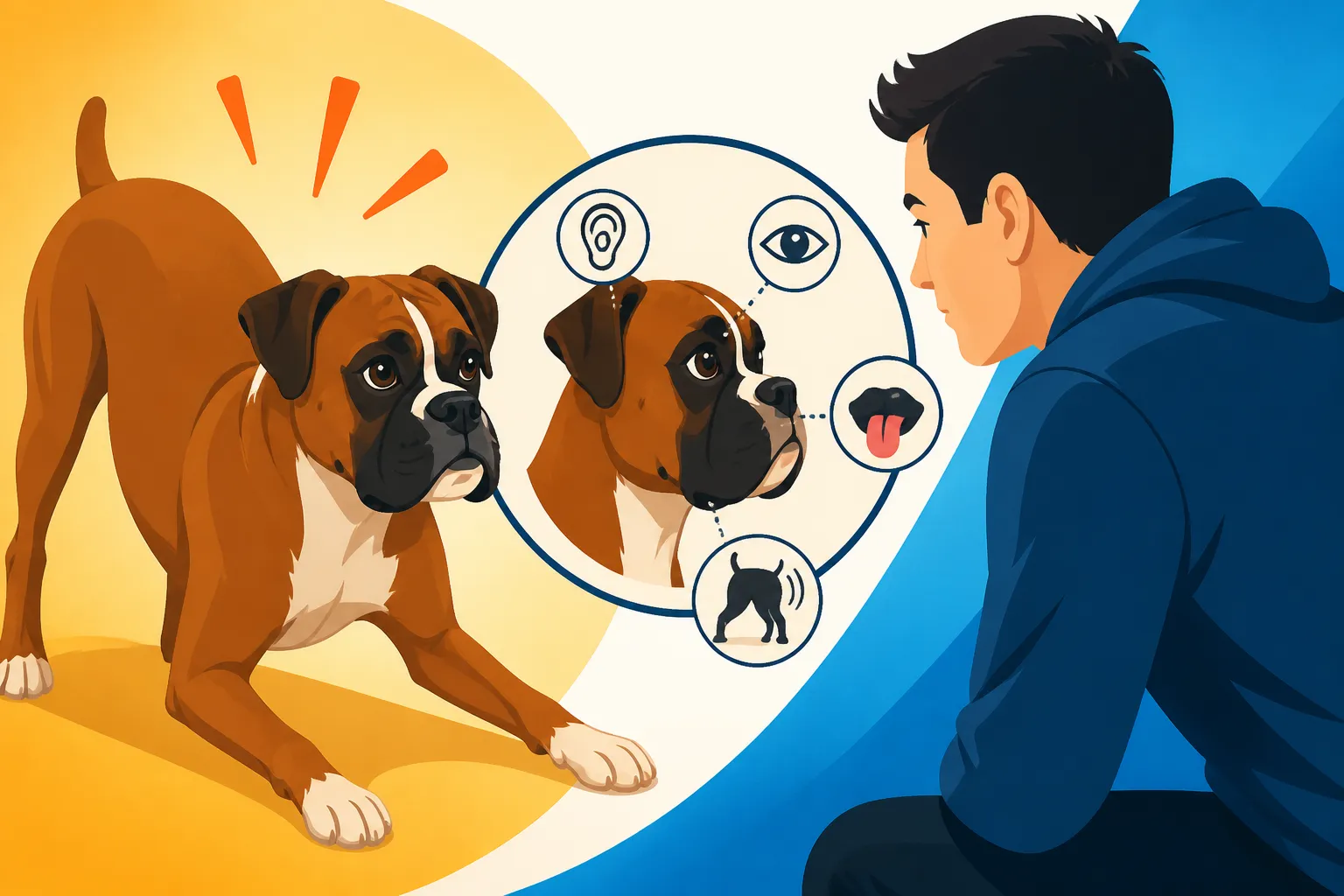
Reading a Boxer Before Play Turns Sharp
We've all been there: one minute your Boxer is joyfully romping, all happy wiggles and play bows, and the next, the energy shifts. Suddenly, the game feels a little too intense, a bit too mouthy, or maybe the other dog (or person!) looks a little overwhelmed. It's tough to know exactly when that line is crossed, especially with such an exuberant breed. This guide is here to help you decipher your Boxer's body language, understand those subtle (and not-so-subtle) cues, and learn how to intervene effectively before play turns genuinely sharp or someone gets accidentally hurt.
The Boxer Play Style: Full-Throttle Fun with a Few Caveats
Boxers are renowned for their incredible zest for life and their unique, often boisterous, play style. It's part of their charm, but it also requires a discerning eye from their owners to ensure that fun doesn't inadvertently tip into overstimulation or roughness.
Understanding Their Energetic Nature
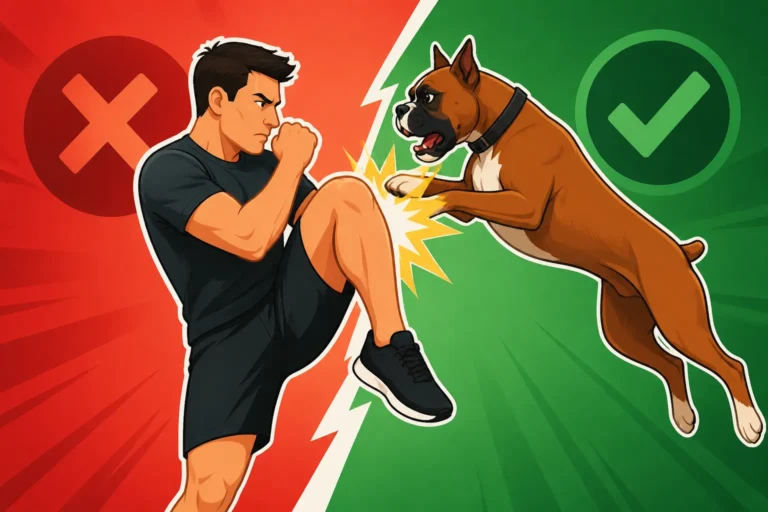
When you bring a Boxer into your home, you're signing up for a dog with an enthusiastic, full-body approach to play. They are physically demonstrative, often using their whole selves to engage. This can mean a lot of bumping, shoulder-checking, and, of course, their signature "boxing" with their front paws. It's not uncommon for a young Boxer to launch themselves into play with an intensity that might surprise a first-time owner or an uninitiated canine companion. They're often happy-go-lucky, wanting everyone to join the party, but their sheer physical power can be a lot. We've talked before about Why a Boxer Boxes With Its Front Paws and how natural this is to the breed, but understanding when that pawing crosses a line is crucial.
This natural exuberance means their energy levels are almost always on high. They might bound around, make quick turns, and engage in high-speed chases. It’s glorious to watch when it’s balanced, but it also means that their threshold for getting overly excited can be lower than some other breeds. Their play isn't usually malicious, but rather a reflection of their deep enthusiasm and sometimes, a lack of subtle social graces. For them, life is an exciting game, and they want to play it at maximum volume.
When "Play" Becomes "Overstimulation"
The challenge with Boxers lies in their tendency to get so revved up that they struggle to self-regulate. What starts as a fun game of tag can quickly morph into relentless chasing, where one dog is no longer enjoying it. A friendly wrestling match can escalate into hard mouthing or even accidental nips as their jaw strength, combined with their excitement, becomes overwhelming. This is particularly noticeable in interactions with smaller dogs or young children, who simply cannot handle the sheer force of a seventy-pound Boxer playing with full abandon.
Signs that play is becoming overstimulation are often subtle at first. Perhaps your Boxer starts to ignore "break" commands or disengage attempts. They might fixate on their playmate, panting heavily even if the temperature isn't high, or their movements might become less fluid and more rigid. This isn't about aggression in most cases; it's about a dog that's gone past its ability to think and respond calmly, running purely on instinct and adrenaline. Their good intentions can still lead to bumps, scratches, or even accidental bruises for humans, and fear or frustration for other dogs. This is where understanding their signals becomes paramount – catching these moments early allows you to redirect the energy before it becomes problematic.
Key Body Language Cues to Watch For
Learning to "read" your Boxer is like learning a new language. They are constantly communicating, not just with barks and growls, but with every twitch of an ear, shift in weight, and gaze of an eye. The trick is to spot these non-verbal cues before the situation gets out of hand.
The Early Warning Signs
These are the subtle nudges that tell you your Boxer is building up steam, and it might be time to gently intervene or change the dynamic of play. Think of them as yellow lights before a red light.
- Stiffening Body: A loose, bouncy Boxer is a happy Boxer. If their body starts to stiffen, their movements become less fluid, or their tail wags with less of a full-body swing and more of a rigid thump, it’s a sign they’re getting more intense. This often precedes a harder tackle or more forceful engagement.
- Hard Stares or "Whale Eye": If your Boxer is staring intently at their playmate, especially if you see the whites of their eyes (often called "whale eye"), it indicates a heightened level of focus that might be bordering on fixation rather than lighthearted play. In true play, eyes are usually soft, darting, and not locked.
- Rapid, Shallow Panting (Not From Heat): While Boxers can overheat easily (and we'll talk about Boxer Exercise Needs and the Heat That Limits Them), excessive panting that doesn't align with the ambient temperature or the level of physical exertion can be a sign of stress or over-arousal. Their breathing might become quick and shallow, rather than deep and regular.
- Increased Speed and Intensity Without Breaks: Healthy play involves pauses, moments of sniffing, shaking off, or breaking eye contact. If your Boxer is constantly "on," running at full speed without taking these little mini-breaks, it's a sign they're becoming overstimulated and might not be able to calm themselves down without your help.
- Low, Rumble Growls That Change: Play growls are normal for Boxers and often sound a bit ridiculous – like a dinosaur in a cartoon. However, if that growl drops in pitch, becomes more sustained, or is accompanied by a tensing of the body rather than a relaxed play posture, it's a warning.
The Escalation Signals
When play really starts to escalate, these are the red flags that demand immediate intervention. This is where you might see discomfort in another dog or person, and the risk of an accidental injury goes up significantly.
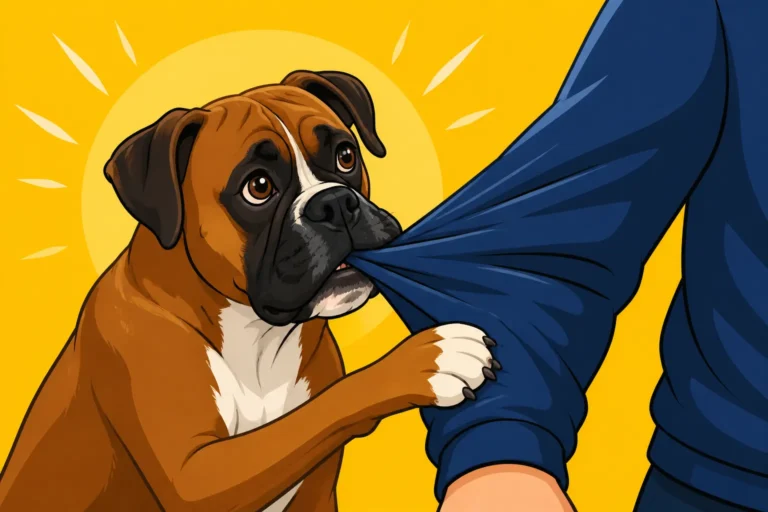
- Hard Mouth Contact (Beyond Soft Mouthing): Boxer puppies are notoriously mouthy, and learning to soften their bite is a key part of their development. However, once grown, their mouthing in play should generally be soft, inhibited, and exploratory, not hard. If teeth are making hard contact, or if the mouthing becomes persistent and forceful, that's a problem. We often discuss Boxer Puppy Biting That Does Not Stop but adult mouthing can also be an issue.
- Persistent Chasing Without Reciprocity: In balanced play, both dogs take turns chasing and being chased. If your Boxer is constantly pursuing another dog that is trying to get away, avoiding eye contact, or cowering, the play has become unbalanced and stressful for the other dog. This is especially true if the chased dog is showing signs of fear or appeasement, like lip licking, yawning, or a tucked tail.
- Pinning or Holding Down: While some wrestling is fine, if your Boxer frequently pins another dog to the ground and holds them there, especially with a direct stare, it's often a sign of dominance rather than mutual play. This can be intimidating and scary for the dog being pinned.
- Raised Hackles: The hair standing up on your Boxer's back or shoulders (their hackles) is a clear involuntary sign of arousal. It doesn't always mean aggression, but it always means high excitement or stress. If you see this, it’s a big signal that the play has become too intense.
- Ignoring Correction or Attempts to Disengage: If you call your Boxer's name, or if their playmate attempts to disengage (walk away, shake off, turn their back), and your Boxer ignores these cues entirely, they are over the top and need your help to calm down.
Recognizing Stress in Play
Sometimes, it's not about your Boxer being "bad," but about them feeling overwhelmed or uncomfortable themselves. Recognizing stress in their play is just as important as recognizing escalation.
- Lip Licking and Yawning: These are classic "calming signals." While a yawn can just mean tiredness, if your Boxer is doing it repeatedly in a high-energy situation, it's a sign they're trying to de-escalate their own arousal or signal to another dog that they're not a threat.
- Turning Head or Body Away: If your Boxer keeps turning their head or body away from the play, especially if they combine it with looking at you, they might be trying to say "I need a break" or "I'm not comfortable."
- Tucked Tail or Flattened Ears: While Boxers have docked tails and often expressive ears, a tucked stump or ears flattened back against their head can still signal apprehension or stress, rather than happy engagement. Compare this to the famous The Boxer Wiggle and What It Signals of happiness.
- Moving in Slow Motion: Sometimes, a Boxer who is truly overwhelmed might move unusually slowly, almost like they're trying to sneak away or make themselves small. This is a clear indicator that they're not enjoying the interaction.
Intervening Effectively and Redirecting Play
Once you've spotted those critical body language cues, the next step is to act. Effective intervention isn't about punishment, but about guiding your Boxer back to a calmer, more appropriate state, and teaching them better self-regulation.
Timing is Everything
The most effective interventions happen at the "yellow light" stage, not the "red light." If you wait until your Boxer is in full-blown overstimulation, it's much harder to break their focus and get them to respond. This is why paying close attention to those early, subtle shifts in body language is so important. By stepping in when things are just starting to get too intense, you prevent negative experiences for all involved and reinforce the idea that you are in charge of managing the play, making it safer and more enjoyable. It also teaches your Boxer that calm choices lead to continued fun, while over-excitement leads to a timeout.
Practical De-escalation Techniques
When you see those early warning signs, here are some practical ways to intervene:
- Call for a "Break": A clear, consistent verbal cue like "Break!" or "Enough!" can be incredibly useful. If your Boxer responds, reward them immediately with a calm praise and perhaps a small, high-value treat. Practice this in less intense situations first.
- Leash for a Timeout: If your Boxer is struggling to disengage, simply clip a leash on them and calmly lead them away from the play area for a few minutes. Don't make a big deal of it or scold them; the timeout itself is the consequence. Once they've settled, you can try reintroducing them to play, or move on to a different activity.
- Redirect with a Toy: Sometimes, all it takes is redirecting that energy. Have a favorite, durable chew toy or a tug toy handy. A good, sturdy rope toy from Amazon can withstand a Boxer's powerful jaws. Throw it, or engage them in a short game of tug away from the primary play area. This shifts their focus and provides an outlet for their energy in a more controlled manner. Remember Teaching a Boxer to Drop It as a fundamental skill for this.
- Change the Environment: If your Boxer is consistently getting over-excited in a particular setting (e.g., a busy dog park), it might be too much for them. Try a quieter park, a controlled playdate with a known, well-matched dog, or a fenced yard where you can manage the interactions more closely.
Managing Play with Other Dogs and Children
Boxers are generally wonderful with children and other dogs, but their enthusiastic nature requires careful management, especially when play gets rough. Boxers With Children and Other Dogs is a crucial topic for many families.
- Supervised Play is Non-Negotiable: Never leave a Boxer unsupervised with young children or smaller, more timid dogs, especially during play. Your presence means you can intervene at the first sign of trouble.
- Teach Children How to Behave: Educate children on how to interact respectfully with dogs. No pulling tails, ears, or riding the dog. Teach them to recognize when the Boxer needs a break and to give the dog space.
- Choose Playmates Wisely: For dog-on-dog play, choose playmates who match your Boxer's energy level and play style. A confident, equally bouncy dog is often a better match than a shy or significantly smaller one. We've discussed Boxer Play Style With Other Dogs in depth, and selecting appropriate companions is key.
- Regular Breaks: Even with compatible playmates, enforce regular breaks. Call your Boxer away for a drink of water, a quick sniff around, or a short walk on a leash to allow their arousal levels to drop.
Setting Boundaries for Sustainable Play
Teaching a Boxer how to play appropriately is an ongoing process that benefits from consistent boundaries, clear expectations, and plenty of structured mental and physical exercise. It's about channeling their immense energy into positive outlets.
Teaching Impulse Control
Impulse control is foundational for managing an excitable Boxer. These are skills that benefit your dog far beyond playtime, improving their overall behavior and responsiveness.
- "Wait" and "Stay" Commands: Practice "wait" before going through a door or for food. Practice "stay" for increasing durations. These commands teach your Boxer to pause and think rather than react instantly. A consistent training program, perhaps guided by online resources like those offered by BAXTER & Bella, can significantly improve impulse control.
- "Leave It" and "Off" Commands: These are invaluable during play. If your Boxer gets too focused on a toy or another dog, "leave it" can help them disengage. "Off" is perfect for when they jump on people or furniture in excitement. Consistent practice in varied environments is key.
- Structured Play Sessions: Instead of just letting them run wild, introduce structured games like fetch or hide-and-seek. These games have clear rules, beginnings, and ends, which help your Boxer learn to control their impulses within a game context.
The Role of Structured Exercise
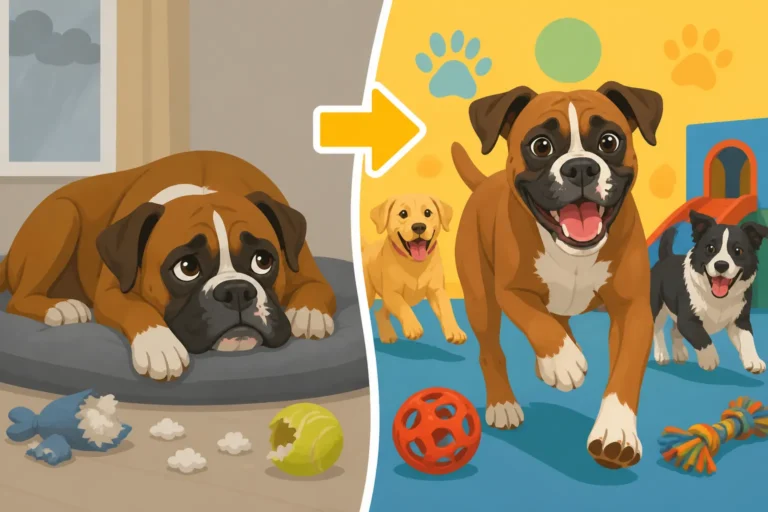
An under-exercised Boxer is a recipe for destructive behavior and over-the-top play. Boxers are powerful, athletic dogs that need a significant amount of physical activity.
- Daily Physical Outlet: This isn't just a quick walk around the block. Boxers need vigorous exercise, often 60-90 minutes a day, split into sessions. This could be brisk walks, jogging (once mature), fetch, or controlled off-leash running in a safe area. If they don't get this, they'll have pent-up energy that can easily manifest as sharp play or general restlessness. For more on this, check out Why a Boxer Wrecks Things When Under-Exercised.
- Mental Stimulation: Don't forget their brains! Boxers are intelligent and get bored quickly. Puzzle toys (many great options are available on Amazon), obedience training, nose work, or learning new tricks can be just as tiring and satisfying as physical exercise. Training a Boxer That Gets Bored Fast delves into this more.
- Table: Playful vs. Escalating Body Language
| Body Language Signal | Playful Boxer | Escalating/Overstimulated Boxer |
|---|---|---|
| Overall Posture | Loose, bouncy, fluid movements, play bows | Stiff, rigid, sudden jerky movements, high head/tail |
| Tail Wag | Wide, full-body wiggle (the "Boxer Wiggle") | Stiff, rapid, short wags; tucked or high/rigid held |
| Mouth/Teeth | Soft, inhibited mouthing; open, relaxed mouth | Hard mouth contact, snapping, persistent nipping |
| Eyes | Soft, darting, relaxed; looking away occasionally | Hard stare, "whale eye," fixated |
| Growls/Vocalizations | High-pitched, playful, short "grumbles" | Low, guttural, sustained growls; louder barking |
| Engagement | Takes breaks, invites reciprocal play, self-regulates | Relentless, ignores disengagement cues, fixates |
| Hackles | Flat | Raised (on neck, back, or shoulders) |
Using Tools for Control
Sometimes, a little help from the right gear can make all the difference in managing your Boxer's energy and ensuring safe interactions.
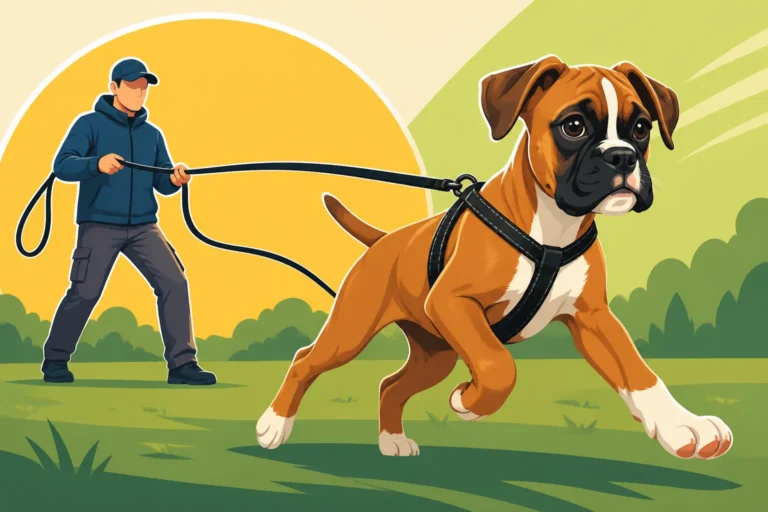
- Appropriate Harnesses and Leashes: A well-fitting front-clip harness can significantly reduce pulling on walks, giving you better control when your Boxer gets excited by another dog or person. Combine this with a sturdy leash for reliable handling. You might find guidance on selecting the right gear through services like BAXTER & Bella that focus on comprehensive training and support. For more on managing pulling, see Harnesses That Hold a Pulling Boxer.
- Long Lines: For practicing recall or supervised off-leash play in unfenced areas, a long line (15-30 feet) can give your Boxer freedom to run while still allowing you to intervene quickly if their play gets too rough or they start to ignore commands.
- Positive Reinforcement Tools: Clickers, high-value treats, and specific verbal markers (like "Yes!") are powerful tools for communicating clearly with your Boxer and reinforcing desired behaviors. They learn that calm, appropriate choices earn rewards, making them more likely to repeat those behaviors.
Understanding your Boxer's unique blend of exuberance and sensitivity is key to a harmonious life together. By consistently observing their body language, intervening proactively, and providing clear boundaries and outlets for their energy, you can ensure that playtime remains fun, safe, and truly joyful for everyone involved.
Disclaimer
This article is for general informational purposes only and does not constitute professional advice. Laws, prices and regulations vary by location and change over time. Consult a qualified professional for guidance on your specific situation.