Boxer Gait and Movement in the Ring
It can be incredibly confusing, standing ringside or even just watching videos, trying to decipher what exactly judges are looking for when a Boxer moves. You might feel a mix of pride watching your own dog zoom across the lawn, yet wonder if their particular brand of joyful chaos would ever impress an expert. This guide is here to demystify the intricacies of Boxer gait and movement, breaking down the breed standard into understandable components so you can better appreciate the athleticism of these incredible dogs, whether they're in the show ring or just tearing up your backyard.
Understanding the Boxer's Breed Standard for Movement
When we talk about a Boxer's movement, we're really talking about a dance between power and grace, a reflection of their history and purpose. It's not just about speed, but about efficiency, strength, and balance. The breed standard, which is the blueprint for what an ideal Boxer should look like and how it should move, provides a very specific description for a reason. It outlines the optimal mechanics that allow a Boxer to perform its historical duties — whether that was working with cattle, or simply moving with purpose and endurance.
Historical Context of the Boxer's Structure
The Boxer descended from a line of dogs like the Bullenbeisser, bred for hunting and holding large game. This heritage demanded a powerful, agile, and resilient dog. The very structure of the Boxer, from its muscular neck and strong back to its deep chest and well-angulated limbs, is a direct result of these working origins. Every bone, every muscle, plays a role in generating the characteristic movement. They weren't just pretty faces; they were built for action, and their movement reflects that deep-seated capability.
Imagine their ancestors needing to swiftly cover ground and then use immense strength and agility to engage with a powerful animal. This isn't a slow, lumbering dog. It's an explosive, coordinated athlete. When you see a Boxer move with purpose, you're witnessing generations of selective breeding for functional excellence. This historical foundation is crucial to understanding why the standard emphasizes certain aspects of their gait, demanding a combination of power, balance, and reach.
Key Anatomical Features Influencing Gait
A Boxer's movement is fundamentally dictated by its underlying anatomy. The angulation of the shoulders and hips, the length of the upper arm and thigh bones, and the strength of the back and loin all contribute significantly to how they carry themselves and propel themselves forward. For instance, proper shoulder angulation allows for excellent forward reach, meaning the front legs can extend far without lifting too high. This conserves energy and makes for an efficient stride.
Similarly, strong, well-angulated rear quarters are essential for powerful drive. The muscles in the rear, particularly the thighs and hocks, act like springs, pushing the dog forward. Without this proper angulation and musculature, a Boxer might struggle to generate the necessary power, leading to a weak or choppy gait. The deep chest, characteristic of the breed, provides ample room for heart and lung capacity, which supports endurance during sustained movement. The overall balance of these features is paramount; a dog might have great front reach but lack rear drive, resulting in an unbalanced, less efficient trot. If you're wondering The Boxer the Breed Standard Describes, you'll see how movement is woven into every aspect of their physical requirements.
The Importance of Balance and Symmetry
Judges often talk about a Boxer moving as a "whole dog," meaning all parts work together in a harmonious and balanced fashion. This symmetry is vital. The front and rear movements should complement each other, with the dog's body maintaining a level topline and its head carried proudly but not excessively high or low. An imbalanced dog might appear to be "pulling" itself forward with its front or "pushing" with its rear, rather than a smooth, coordinated effort from both ends.
Think of it like a perfectly tuned engine where all cylinders fire in sync. If one part is off, the whole machine is less efficient. In a Boxer, this means the front reach should equal the rear drive, allowing the dog to move smoothly and effortlessly without wasted motion. A truly balanced Boxer will appear to float across the ground, its powerful strides covering maximum distance with minimal effort. This harmonious movement is a hallmark of a well-constructed Boxer and is deeply valued in the show ring.
The Ideal Boxer Gait: What Judges Look For
When a Boxer enters the show ring, its movement is put under a microscope. Judges aren't just looking for a dog that can run; they're evaluating a specific type of movement that speaks to the breed's function, structure, and endurance. It's a precise combination of power, elegance, and efficiency that truly sets an exemplary Boxer apart.
The "Elastic" Trot: Power and Reach
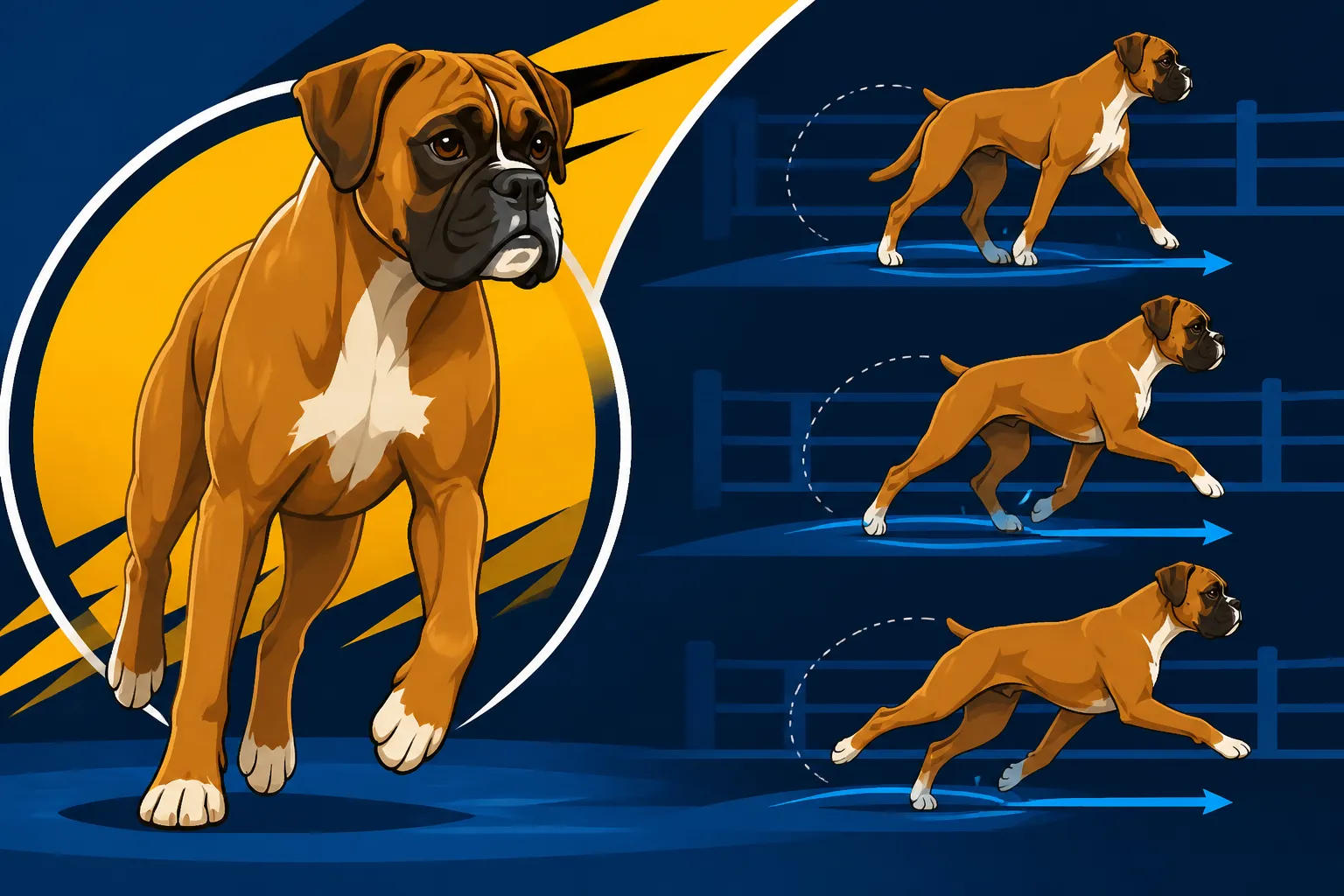
The hallmark of an ideal Boxer gait is often described as an "elastic" trot. What does "elastic" even mean in this context? It refers to a powerful, springy, and resilient quality to their stride. The dog should cover a significant amount of ground with each step, demonstrating both impressive forward reach from the front legs and strong, driving propulsion from the rear. The forelegs should reach out smoothly, almost effortlessly, covering distance without appearing to high-step or paddle.
Simultaneously, the hind legs should drive powerfully forward, tracking in line with the front feet. This elasticity ensures that while the movement is powerful, it's also smooth and fluid, not stiff or jarring. There should be a visible spring in their step, reflecting both strong musculature and correct joint angulation. It's a breathtaking sight when you witness a Boxer moving with this perfect combination of power and fluidity.
Effortless and Ground-Covering Movement
An ideal Boxer's movement should appear absolutely effortless. There shouldn't be any wasted motion, no high-stepping, no excessive bouncing or swaying. Every part of their body should contribute to covering as much ground as possible with each stride. This is why a smooth, extended trot is preferred over a frantic gallop in the show ring. The goal is to demonstrate endurance and efficiency.
The term "ground-covering" is key here. It means the dog's strides are long and purposeful, eating up the ground beneath them. A Boxer with an excellent ground-covering gait will move with purpose, appearing to glide rather than struggle. This efficiency is directly linked to correct anatomical structure and balance, allowing the dog to maintain its powerful trot for extended periods, a testament to its athletic build and stamina. This is crucial for their overall well-being, as Boxer Exercise Needs and the Heat That Limits Them often dictate how much physical activity they can sustain.
Proper Foot Placement and Drive
As the Boxer moves, its legs should track straight, with the feet converging towards a center line as speed increases. This single-tracking, or converging, motion provides balance and efficiency, much like a tightrope walker adjusting their steps to stay centered. The paws themselves should appear firm, with strong pasterns, and should not splay out or turn in. Each footfall should be precise and purposeful.
The rear drive is equally important. Strong hindquarters push the dog forward with power, and the hocks should be well-let down, flexing powerfully with each stride. A common fault is a lack of rear drive, where the hind legs seem to merely follow rather than propel. A Boxer with excellent drive will show clear, strong propulsion from its rear, indicating powerful muscles and correct angulation, propelling them gracefully around the ring or, more likely, around your local park.
Common Movement Faults in Boxers
Even the most beautiful Boxer can have movement faults that detract from its overall impression in the show ring. These faults aren't just cosmetic; they often indicate structural weaknesses or imbalances that can affect a dog's long-term health and athletic ability. Understanding them helps both judges and owners recognize potential issues.
Paddling, Crabbing, and Hackneying
These are three common terms used to describe undesirable front-end movement:
- Paddling: This occurs when the front feet swing out wide in an arc rather than tracking straight forward. It's often seen in Boxers with too much width in their chest or incorrect shoulder angulation. It's an inefficient movement, wasting energy and lacking elegance.
- Crabbing (or Sidewinding): This is when the dog moves with its body at an angle to the direction of travel, seemingly moving sideways. It often happens when the rear legs are trying to compensate for a front-end fault, or vice-versa, creating an imbalanced gait. It's a clear sign that the dog's front and rear aren't working in harmony.
- Hackneying: Named after the high-stepping hackney horse, this fault involves the dog lifting its front feet too high, almost as if prancing, rather than extending them forward to cover ground. It wastes energy and reduces the efficiency of the stride, making the movement less fluid and powerful.
Any of these faults can signal a lack of proper structure, affecting the Boxer's ability to move with the desired elasticity and ground-covering efficiency. For any owner, recognizing these in your own Boxer might warrant a discussion with your vet or a canine physiotherapist to ensure your dog isn't overcompensating or developing discomfort.
Weak Rear End Movement and Lack of Drive
A Boxer should have powerful, driving hindquarters. When a dog exhibits weak rear end movement, it means the hind legs lack the strong push-off necessary for an efficient trot. This can manifest as short, choppy strides, or the dog might appear to be "lugging" its rear rather than propelling it. The hocks might not flex properly, or the dog might not extend its rear legs fully back.
This lack of drive often stems from insufficient angulation in the rear, weak musculature, or even pain in the hips or lower back. It can severely impact a Boxer's ability to cover ground and maintain stamina. A Boxer that is lacking drive will tire more quickly and will not have that characteristic powerful, elastic stride that is so admired. It's a common area of concern for many Boxer owners, especially as their dogs age, and can sometimes be connected to issues like Boxer Hip Dysplasia and Spondylosis.
Improper Reach and Short Strides
Another significant fault is improper reach, where the front legs do not extend sufficiently forward. Instead of a long, sweeping stride, the dog takes short, quick steps, failing to cover adequate ground. This "short-striding" often goes hand-in-hand with a lack of elasticity. The front feet might appear to barely clear the ground or might land too close to the body.
This can be due to overly straight shoulder angulation, a short upper arm, or even tight muscles. Similarly, the rear legs might also take short strides, failing to extend fully behind the dog. When both front and rear are short-striding, the overall movement becomes choppy and inefficient. The Boxer loses its ability to flow smoothly and powerfully across the ground, appearing instead to scurry or peck at the ground rather than stride over it.
How Health Conditions Can Affect Boxer Movement
While structure and genetics play a massive role in a Boxer's natural movement, various health conditions can emerge, often unexpectedly, to drastically alter their gait. It's one of the hardest things as an owner to watch your active, playful Boxer start to move differently, knowing it's often a sign of underlying discomfort or disease. Being attuned to these changes is paramount for their well-being.
Arthritis and Joint Issues
Arthritis, especially in the hips, elbows, or spine, is a common culprit for changes in movement, particularly in older Boxers. What starts as a subtle stiffness after rest can progress to a noticeable lameness or a reluctance to move. You might notice your Boxer taking shorter steps, favoring a limb, or struggling with stairs or jumping onto furniture. This isn't just a sign of aging; it's pain. Conditions like Arthritis in an Older Boxer can significantly diminish their range of motion and overall agility.
The beautiful, elastic trot becomes guarded and rigid as the dog tries to minimize discomfort in its joints. Their once powerful rear drive might diminish, leading to a weaker push-off and an altered stance. While we can't reverse arthritis, early recognition and management through veterinary care, pain relief, joint supplements (many of which you can find readily on platforms like Chewy), and controlled exercise can significantly improve their quality of life and help maintain as much comfortable movement as possible.
Cardiac Conditions and Stamina
Boxers are predisposed to certain heart conditions, most notably Arrhythmogenic Right Ventricular Cardiomyopathy (ARVC), sometimes called "Boxer Cardiomyopathy." While this condition primarily affects the heart's electrical system, leading to arrhythmias and sometimes sudden collapse, it can also manifest in subtle ways related to movement and stamina. A Boxer with an undiagnosed or poorly managed cardiac issue might show reduced exercise tolerance.
Where they once would tirelessly chase a ball, they might now tire quickly, lag behind on walks, or even seem reluctant to engage in vigorous play. This isn't a problem with their mechanics, but with their engine's ability to sustain the effort. Owners might notice their Boxer slowing down, seeking rest more frequently, or even having short coughing spells after exertion. These are critical signs that warrant immediate veterinary attention, as they indicate the heart is struggling to keep up with the demands of movement. Understanding What Boxer ARVC Actually Does to the Heart is vital for any Boxer owner.
Neurological Impact on Gait
Neurological issues can sometimes present as profound changes in a Boxer's movement, often mimicking orthopedic problems. Conditions like Degenerative Myelopathy (DM), a progressive spinal cord disease common in Boxers, can lead to hind limb weakness, ataxia (incoordination), and eventually paralysis. The initial signs can be very subtle: a slight dragging of a back foot, scuffing of nails, or an unusual sway in the hindquarters.
Other neurological problems, such as disc disease or spinal tumors, can also cause pain, weakness, or nerve impingement that directly alters how a Boxer moves. The once coordinated gait becomes clumsy or unbalanced. You might see a Boxer crossing its back legs, struggling with balance, or showing a pronounced sway from side to side. These changes are deeply distressing for owners and require prompt neurological evaluation to identify the cause and explore potential treatments. Understanding how to manage Watching a Boxer Lose Its Back Legs due to conditions like DM can be emotionally challenging, highlighting the importance of early diagnosis.
Training and Conditioning for Optimal Movement
While genetics provide the blueprint for a Boxer's movement, proper training and conditioning can significantly enhance their natural abilities and help them maintain optimal gait throughout their lives. It's not just about what they can do, but how well they do it, and how long they can continue to move comfortably and powerfully.
Building Core Strength and Flexibility
Just like human athletes, Boxers benefit immensely from a strong core. A robust core supports the spine, improves balance, and allows for more efficient transfer of power from the rear to the front. Exercises that engage the core, such as controlled walks over varied terrain, balance exercises on unstable surfaces (like wobble boards or fit paws equipment), and gentle stretches, can significantly improve a Boxer's stability and flexibility. Think about activities that encourage them to engage their abdominal muscles and stretch their limbs fully.
Incorporating these into their routine, even for just a few minutes a day, can make a noticeable difference in their gait, making their movements more fluid and less prone to injury. A strong, flexible Boxer is less likely to compensate with improper movement patterns, and more likely to maintain that desired elastic trot well into their senior years. This kind of thoughtful conditioning is especially important when you consider The Boxer Puppyhood That Lasts Three Years, as good habits established early pay dividends later.
Proper Leash Training and Ring Craft
Even a Boxer with perfect structure can appear clumsy in the ring if they haven't been properly leash trained. A dog that pulls, lunges, or constantly shifts its attention will never show off its true movement potential. Loose-leash walking, where the dog learns to trot politely by your side without tension on the lead, is fundamental. This isn't just for the show ring; it makes everyday walks more enjoyable and helps your dog develop a natural, balanced stride.
For those considering the show ring, ring craft goes a step further. It involves teaching the Boxer to hold a consistent speed, turn gracefully, and stack confidently. This specialized training helps present the dog's movement in the best possible light, allowing the judge to see their natural gait without interference. It’s about teaching them to be confident and comfortable in that specific environment, rather than Building Confidence in a Shy Boxer while also trying to teach them to move.
Nutritional Support for Joint Health
Nutrition plays a surprisingly large role in supporting healthy movement, particularly for a breed like the Boxer known for its athleticism and predisposition to certain joint issues. A balanced diet provides the building blocks for strong bones, healthy cartilage, and resilient connective tissues. High-quality protein supports muscle mass, which in turn helps stabilize joints. For instance, reputable brands found on sites like Chewy offer formulations specifically designed for large, active breeds.
Beyond a foundational diet, many Boxer owners also consider supplements. Glucosamine and chondroitin, often combined, are popular choices for supporting joint cartilage. Omega-3 fatty acids, like those found in fish oil, can help reduce inflammation, which is crucial for dogs with arthritis or those undergoing strenuous activity. Even products from Chewy like high-quality joint chews can contribute to their overall mobility and comfort, making every movement a little easier. When you're feeding Protein and Fat for a Muscular Boxer, remember that their joints need support too.
Evaluating a Boxer's Movement: Beyond the Show Ring
While the show ring demands a very specific, formal assessment of a Boxer's gait, understanding healthy movement extends far beyond competition. As Boxer owners, being able to recognize what "normal" looks like for your dog, and spotting subtle changes, is one of the most important things you can do for their health and well-being.
Observing Natural Movement in Everyday Life
The best way to understand your Boxer's natural gait is to watch them move freely, without the constraints of a leash or the pressure of a show ring. Observe them when they play in the yard, when they're greeting you excitedly, or when they're simply trotting across the kitchen floor. Do their legs move symmetrically? Is their stride fluid and effortless? Do they carry their head and tail naturally? Pay attention to how they get up from a lying position, how they navigate stairs, and how they turn.
These everyday observations give you a baseline for your individual dog. Every Boxer is unique, and while the breed standard provides an ideal, your Boxer's "normal" might have slight variations. The key is to know what is normal for your dog, so you can quickly identify when something seems off. This informal assessment is often the first step in catching potential health issues before they become more serious.
Recognizing Subtle Changes in Gait
Subtle changes can be incredibly hard to spot, especially if you see your dog every day. But they are often the earliest indicators of underlying discomfort or developing health conditions. Look for things like a slight limp that comes and goes, a decreased willingness to jump or climb, a reluctance to use one leg as much as the other, or a general slowing down. You might notice them favoring a certain side, or struggling to maintain balance on uneven ground.
Sometimes, the change isn't in their stride but in their attitude towards movement. A dog that once bounded with joy might now trot sedately, or a dog that loved fetching might stop after fewer throws. Even a shift in how they hold their tail or head during movement can be a clue. Keeping a mental log, or even a literal one, of how your Boxer typically moves and behaves can be invaluable. It's often these small shifts that tell you it's time to investigate further.
Working with a Vet or Professional
If you notice any persistent or concerning changes in your Boxer's movement, or if you simply have questions about their gait, don't hesitate to consult with your veterinarian. They are trained to assess lameness, pinpoint sources of pain, and diagnose underlying conditions. They might perform a physical examination, orthopedic tests, or even recommend diagnostics like X-rays, blood tests, or specialized imaging. They can also advise on appropriate dietary supplements or lifestyle adjustments, and many of these can be easily sourced from a brand like Chewy, making compliance much simpler for busy owners.
For more complex movement issues, your vet might refer you to a veterinary specialist, such as an orthopedic surgeon, a neurologist, or a physical therapist. These professionals can offer advanced diagnostics and rehabilitation strategies tailored to your Boxer's specific needs. proactive engagement with veterinary professionals is key to ensuring your Boxer maintains comfortable and healthy movement for as long as possible, keeping them happy and active members of your family.
Comparative Look at Boxer Movement Characteristics
To give you a clearer picture, here's a brief comparison of ideal Boxer movement versus common faults. This table highlights key distinctions that judges and owners alike should look for.
| Characteristic | Ideal Boxer Movement (Show Ring Standard) | Common Movement Faults | Implications |
|---|---|---|---|
| Overall Impression | Fluid, powerful, elastic, effortless, ground-covering. | Stiff, choppy, heavy, unbalanced, high-stepping. | Indicates good structure/health vs. potential pain, weakness, or poor conformation. |
| Front Reach | Long, sweeping, extends well forward, covers ground efficiently. | Short strides, paddling (feet swing out), hackneying (high-stepping). | Efficient energy use vs. wasted motion, reduced endurance. |
| Rear Drive | Strong, powerful push-off, hocks flex well, propels body forward. | Weak push, hindquarters drag, short steps, no "follow-through." | Excellent propulsion vs. lack of power, potential hip/back issues. |
| Tracking | Legs track straight, converging towards a center line at speed. | Crabbing (moving sideways), splaying (feet spread wide). | Stability and efficiency vs. imbalance, structural problems. |
| Topline | Remains firm and level during movement. | Rolls, bounces, sways excessively. | Strong back and core vs. weak core, spinal issues, or poor balance. |
| Head Carriage | Carried proudly but naturally, in proportion to movement. | Excessively high (prancing) or low (lugging). | Balanced posture vs. compensation for discomfort or poor balance. |
This table provides a quick reference, but remember that observation of your individual dog over time is your best tool for understanding their unique movement patterns.
Disclaimer
This article is for general informational purposes only and does not constitute professional advice. Laws, prices and regulations vary by location and change over time. Consult a qualified professional for guidance on your specific situation.