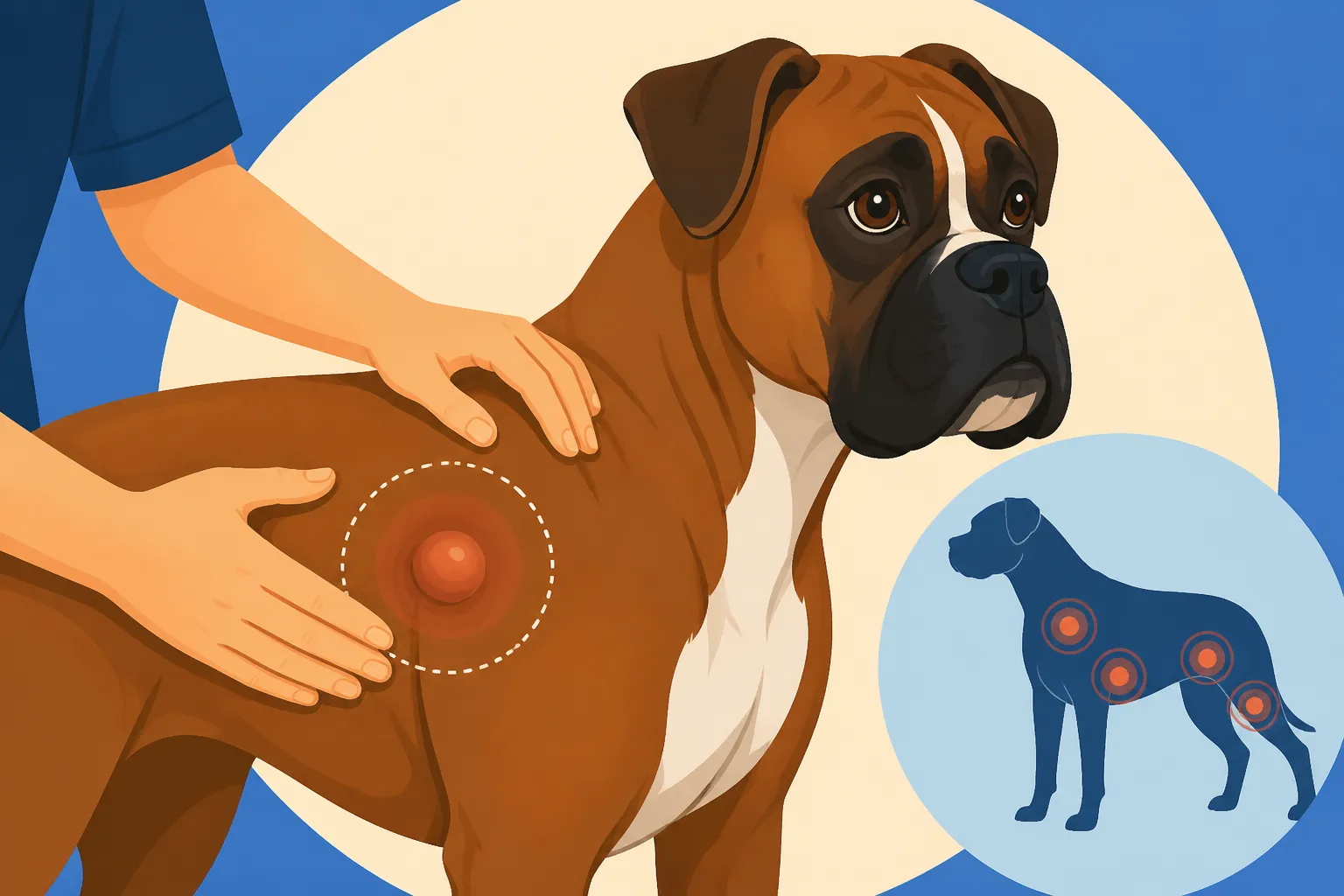
Running Hands Over a Boxer for Lumps
One of the most heart-stopping moments for any Boxer parent is running your hand over that sleek, muscular body only to feel something new – a lump, a bump, a growth that wasn't there yesterday. Boxers, bless their goofy, loving hearts, are incredibly prone to developing these little mysteries, and given their unfortunate predisposition to certain cancers, every new discovery can send a wave of panic through you. This guide is all about empowering you with the knowledge and routine to proactively monitor your Boxer's skin, understand what you're feeling, and know exactly when it's time to reach out to your veterinarian.
Why Lumps Are Such a Big Deal for Boxer Owners
It's a tough truth that we, as Boxer guardians, have to face: our beloved breed is disproportionately affected by certain types of tumors. This isn't to say every lump is a death sentence – far from it – but it does mean we need to be more vigilant than owners of many other breeds. The unique genetic makeup of the Boxer makes them a hotspot for growths, both benign and malignant, and early detection truly can make all the difference.
The Boxer's Genetic Predisposition to Lumps
Boxers carry a genetic burden when it comes to certain types of cancers, especially mast cell tumors and lymphomas. It's not just bad luck; it's woven into their DNA. This predisposition means that while any dog can get a lump, a Boxer is statistically more likely to develop one, and more likely for that lump to be something serious. You might find a perfectly harmless fatty tumor, or lipoma, on your Labrador, but on a Boxer, that same-looking lump warrants a much closer look. It's why regular, thorough checks aren't just a suggestion; they're an essential part of responsible Boxer ownership, especially as they age. Whether Boxer Cancer Risk Is Inherited touches on this in more detail.
Not All Lumps Are Cancer, But Many Are Serious
It’s crucial to understand that "lump" is a broad term. It can refer to anything from a tiny skin tag to a large, aggressive tumor. Some common non-cancerous lumps in Boxers include sebaceous cysts, which are blocked oil glands, or benign lipomas. You might also encounter histiocytomas, which are benign skin tumors often found in younger Boxers that typically resolve on their own. However, the serious ones, like mast cell tumors, can look deceptively innocent. They might start small, feel soft, and even appear to shrink and grow. This variability is precisely why every new lump on a Boxer, regardless of how "normal" it seems, should be brought to your vet's attention for a proper diagnosis.
The Emotional Burden of Finding a Lump
Let's be honest: finding a lump on your Boxer is terrifying. It's a gut punch that immediately brings up fears about their health and future. We pour our hearts into these dogs, and the thought of them suffering from something like cancer is almost unbearable. This emotional toll can sometimes lead to denial or hesitation in seeking veterinary advice, hoping it will just go away. But remember, confronting these fears head-on with proactive checks and prompt vet visits is the kindest thing you can do for your Boxer. It's okay to feel scared, but don't let that fear paralyze you when action is needed. Knowing When a Boxer With Cancer Has Had Enough is a heavy read but important for perspective.
Your Weekly Routine: How to Perform a Thorough Lump Check
Making a thorough lump check a regular part of your routine is perhaps the single most impactful thing you can do to protect your Boxer. Just like brushing their teeth or trimming their nails, it should become second nature. Dedicate a specific time each week when you can spend 10-15 minutes giving your dog a full-body "once-over." This isn't just about finding lumps; it's also a fantastic bonding experience, and it gets your Boxer used to being handled all over, which makes vet visits easier.
Starting at the Head and Working Your Way Down
When you begin your weekly check, it's best to adopt a systematic approach so you don't miss anything. Start at your Boxer's head. Gently feel their skull, around their ears (inside and out), under their chin, and along their jawline. Don't forget their muzzle, paying close attention to the folds around their nose and lips where debris can collect and lumps can hide. Move down their neck, feeling for swollen lymph nodes. Then, continue down their shoulders, chest, and front legs, running your hands along every muscle and bone. Work your way along their back, sides, and belly. Finish by checking their rear legs, tail, and the sensitive area around their privates. The key is to be thorough, feeling the entire surface of their body. Weekly Lump Checks on a Boxer provides a more in-depth guide to this routine.
The Importance of Skin Folds and "Hidden" Areas
Boxers have loose skin and delightful wrinkles, especially around their muzzle and neck, and these areas can be prime hiding spots for lumps. Don't just skim over these folds; gently stretch and palpate them. Pay close attention to:
- Armpits and Groin: Lymph nodes are in these areas, and swellings here are always a red flag.
- Between the Toes: Small cysts or masses can develop here and often go unnoticed until they become painful.
- Under the Tail and Around the Anus: Less pleasant to check, but absolutely essential.
- Inside the Mouth: While trickier, a quick check of gums and cheeks can sometimes reveal growths.
- Ear Flaps (inside and out): Especially if your Boxer has natural ears, look for bumps or crusty patches.
- Mammary Glands (females, spayed or intact): Tumors here are common and can be very serious.
These "hidden" spots are often where aggressive tumors can gain a foothold before they become externally obvious.
What to Feel For: Size, Texture, Mobility
As you run your hands over your Boxer, you're not just looking for any lump, but noticing its characteristics.
- Size: Is it tiny, pea-sized, or larger? Has it grown since the last time you checked?
- Texture: Is it soft and squishy, like a fatty lump? Firm and rubbery? Hard as bone? Does it feel like a wart or a skin tag?
- Mobility: Can you move the lump freely under the skin, or does it feel fixed to underlying tissue or muscle? Generally, mobile lumps are less concerning than those fixed in place, but this is not a hard and fast rule.
- Soreness: Does your Boxer flinch or show discomfort when you touch it?
- Appearance: Is the skin over the lump red, inflamed, or ulcerated? Is there any discharge?
These details are vital information for your vet. Telling a Boxer Fatty Lump From a Tumor delves into how tricky it can be to differentiate them without professional help.
Keeping Track: Documenting Any New Findings
Once you find a lump, the immediate urge might be to panic. But the next, more productive step, is to document it. Waiting weeks to see if it changes without any record is a gamble you don't want to take with your Boxer. A consistent record helps you track changes and provides your vet with invaluable information for diagnosis and monitoring.
Creating a "Lump Map" for Your Boxer
A "lump map" is a simple, yet highly effective, tool. Get a notebook or a piece of paper and draw a simple outline of a dog, or even better, print out a blank dog anatomy chart. Every time you find a new lump, mark its location on the map.
For each lump, record:
- Date found: Crucial for tracking growth rate.
- Location: Be as precise as possible (e.g., "right rib cage, just behind the elbow").
- Size: Measure it with a ruler or calipers. Even a simple estimate like "pea-sized" or "quarter-sized" is better than nothing, but exact measurements are best.
- Description: Note its texture, mobility, and any other observations (e.g., "soft, freely movable," "firm, fixed to rib," "red and crusty").
- Photo: Take a clear photo, if possible, for visual comparison over time.
This map becomes your Boxer's personal health journal and an indispensable resource.
Tracking Changes in Existing Lumps
The lump map isn't just for new discoveries. It's equally important for monitoring lumps that your vet has deemed benign or is currently watching. Re-measure and re-describe these existing lumps during your weekly checks. Pay close attention to:
- Growth: Is it getting bigger, even slightly?
- Change in texture: Did it become harder or softer?
- Change in mobility: Was it movable and now feels fixed?
- Changes to overlying skin: Any redness, hair loss, or ulceration?
Even seemingly minor changes can be significant. If you use a resource like Chewy for your pet supplies, you might consider adding a small notebook and a flexible measuring tape to your regular order, specifically for these checks.
Tools and Apps for Digital Record Keeping
While a physical notebook works perfectly, some owners prefer digital solutions. There are various pet health apps available that allow you to log health concerns, upload photos, and track measurements over time. Look for apps that allow detailed notes and photo uploads. Even a simple note-taking app on your phone, coupled with your camera, can serve this purpose. For instance, creating a dedicated album for your Boxer's lumps in your phone's photo gallery and adding notes to each image can be a streamlined way to track progress. Whichever method you choose, consistency is key. Maintaining a detailed record is empowering and ensures you can provide your vet with a comprehensive history.
When to Call the Vet: Deciphering the Signs
This is often the hardest part – deciding if a lump warrants an immediate vet visit or if it can wait. My rule of thumb for Boxers is always: when in doubt, get it checked. Given their breed-specific risks, being overly cautious is never a bad thing. However, there are definitely certain signs that indicate you need to pick up the phone right away.
Red Flags: Rapid Growth, Soreness, Ulceration
While all new lumps on a Boxer should eventually be seen by a vet, some characteristics demand immediate attention. These are the red flags:
- Rapid Growth: A lump that appears suddenly and grows noticeably within days or a couple of weeks is highly suspicious.
- Soreness or Pain: If your Boxer reacts negatively when the lump is touched, or if they are licking, scratching, or rubbing the area excessively.
- Ulceration or Bleeding: Any lump that has an open wound, is oozing, or bleeding needs immediate veterinary attention. This can indicate an infection or a more aggressive type of tumor.
- Changes in Shape or Consistency: A lump that changes from soft to hard, or from mobile to fixed, is concerning.
- Location: Lumps near joints, lymph nodes (neck, armpits, groin), or internal organs are often more urgent.
These signs do not guarantee a malignancy, but they certainly increase the likelihood and warrant prompt investigation.
The "Wait and See" Trap vs. Proactive Action
It's tempting to think, "Oh, it's probably nothing," and adopt a "wait and see" approach. Unfortunately, with Boxers and their propensity for aggressive cancers, this can be a dangerous trap. Mast cell tumors, for example, can appear benign on the surface but be highly aggressive internally. Waiting until a lump is large, ulcerated, or causing discomfort often means a more complicated and expensive treatment plan, and sometimes, it can be too late.
A proactive approach means getting any new lump checked quickly, even if it seems small and harmless. The sooner a diagnosis is made, the better the prognosis, especially if it turns out to be cancerous. Needle Biopsy on a Boxer Lump is usually the first step your vet will take, and it's a quick, minimally invasive procedure that can provide crucial answers.
What to Expect at the Vet: Initial Assessment
When you bring your Boxer in for a lump check, your vet will perform a thorough physical exam, noting the lump's location, size, and characteristics, just like you've been doing. They will likely recommend a Fine Needle Aspirate (FNA). This involves using a small needle to collect cells from the lump, which are then examined under a microscope. It's a quick procedure, often done right in the exam room, and usually requires no sedation.
Depending on the results of the FNA, your vet might then recommend:
- Monitoring: If the FNA is benign (e.g., a fatty tumor or cyst), they might suggest monitoring it for changes.
- Biopsy: If the FNA is inconclusive or suggests a more serious type of growth (like a mast cell tumor), a surgical biopsy might be needed for a definitive diagnosis.
- Removal: For certain types of lumps, surgical removal might be recommended, sometimes even before a full biopsy, especially if it's small and easily accessible.
The path forward depends entirely on what the lump is, which is why that initial assessment is so critical. The Lumps a Boxer Owner Has to Check For gives a good overview of what these visits might entail.
Understanding Common Boxer Lumps
As a Boxer owner, it helps to be familiar with the types of lumps your dog is most susceptible to. While you should never self-diagnose, knowing the common culprits can help you communicate more effectively with your vet and understand the urgency behind their recommendations.
Mast Cell Tumors: The Big Worry
Mast cell tumors (MCTs) are perhaps the most talked-about cancer among Boxer owners, and for good reason. Boxers have a significantly higher risk of developing them than many other breeds. These tumors can appear anywhere on or under the skin and can vary wildly in appearance. They might be a small, firm bump, or a soft, squishy mass that seems to fluctuate in size. Some can be red and itchy, while others are skin-colored and innocuous-looking. This unpredictability is what makes them so dangerous. Why Boxer Mast Cell Tumors Change Size is a fascinating read about this characteristic. Early detection and complete surgical removal with wide margins are often key to a good prognosis.
Lipomas, Cysts, and Other Benign Growths
Thankfully, not every lump is a mast cell tumor! Boxers also get their fair share of benign growths:
- Lipomas: These are fatty tumors. They are usually soft, movable, and feel like a lump of dough under the skin. They are typically harmless and often left alone unless they grow very large, impede movement, or bother the dog.
- Sebaceous Cysts: These occur when a sebaceous (oil) gland becomes blocked. They often feel like a small, firm bump and might express a white, pasty substance if they rupture. They're generally benign but can become infected.
- Skin Tags: Small, fleshy growths that protrude from the skin. Usually harmless.
- Warts (Papillomas): Caused by a virus, these often appear as small, cauliflower-like growths, especially in younger dogs or around the mouth. They typically resolve on their own. Whether a Boxer Wart Needs Removing covers this in more detail.
While these are generally benign, they still warrant an initial vet check to confirm their identity. The appearance alone is rarely enough for a definitive diagnosis.
Histiocytomas: The Puppy Bumps That Disappear
Histiocytomas are interesting. These are benign skin tumors, most commonly found in young Boxers, usually under two years of age. They often appear as small, raised, hairless, red bumps, and can grow quite quickly. What makes them unique is that they almost always resolve spontaneously within two to three months, often crusting over and disappearing completely. While they look concerning, they're generally harmless. However, because they can be confused with more serious lumps, even a suspected histiocytoma should still be checked by your vet to confirm the diagnosis and ensure it's not something else.
It's a lot to take in, but becoming hyper-aware of your Boxer's body and diligent with your checks is the best defense you have against the challenges their genetics sometimes throw their way.
| Type of Lump | Typical Appearance | Common Location | Usual Age Affected | Urgency Level | Key Characteristics |
|---|---|---|---|---|---|
| Mast Cell Tumor | Varies greatly; can be soft, firm, red, ulcerated | Anywhere on body, common on limbs | Any age, more in older dogs | High | Can fluctuate in size; "fixed" feeling is concerning. |
| Lipoma | Soft, squishy, movable, under the skin | Trunk, armpits, groin | Middle-aged to older dogs | Low to Moderate | Generally harmless, grows slowly, feels like fatty tissue. |
| Histiocytoma | Small, red, raised, hairless "button" | Face, ears, limbs | Young dogs (<2 yrs) | Moderate | Often resolves spontaneously within 2-3 months. |
| Sebaceous Cyst | Firm bump, may rupture and express white/cheesy material | Anywhere, often on back or head | Any age | Low to Moderate | Can become infected; blocked oil gland. |
| Skin Tag | Small, fleshy projection from skin | Anywhere, often around joints | Any age | Low | Usually harmless, no major concern. |
| Wart (Papilloma) | Cauliflower-like growth | Mouth, lips, eyelids | Young dogs | Low | Viral in origin, often regresses on its own. |
This article is for general informational purposes only and does not constitute professional advice. Laws, prices and regulations vary by location and change over time. Consult a qualified professional for guidance on your specific situation.