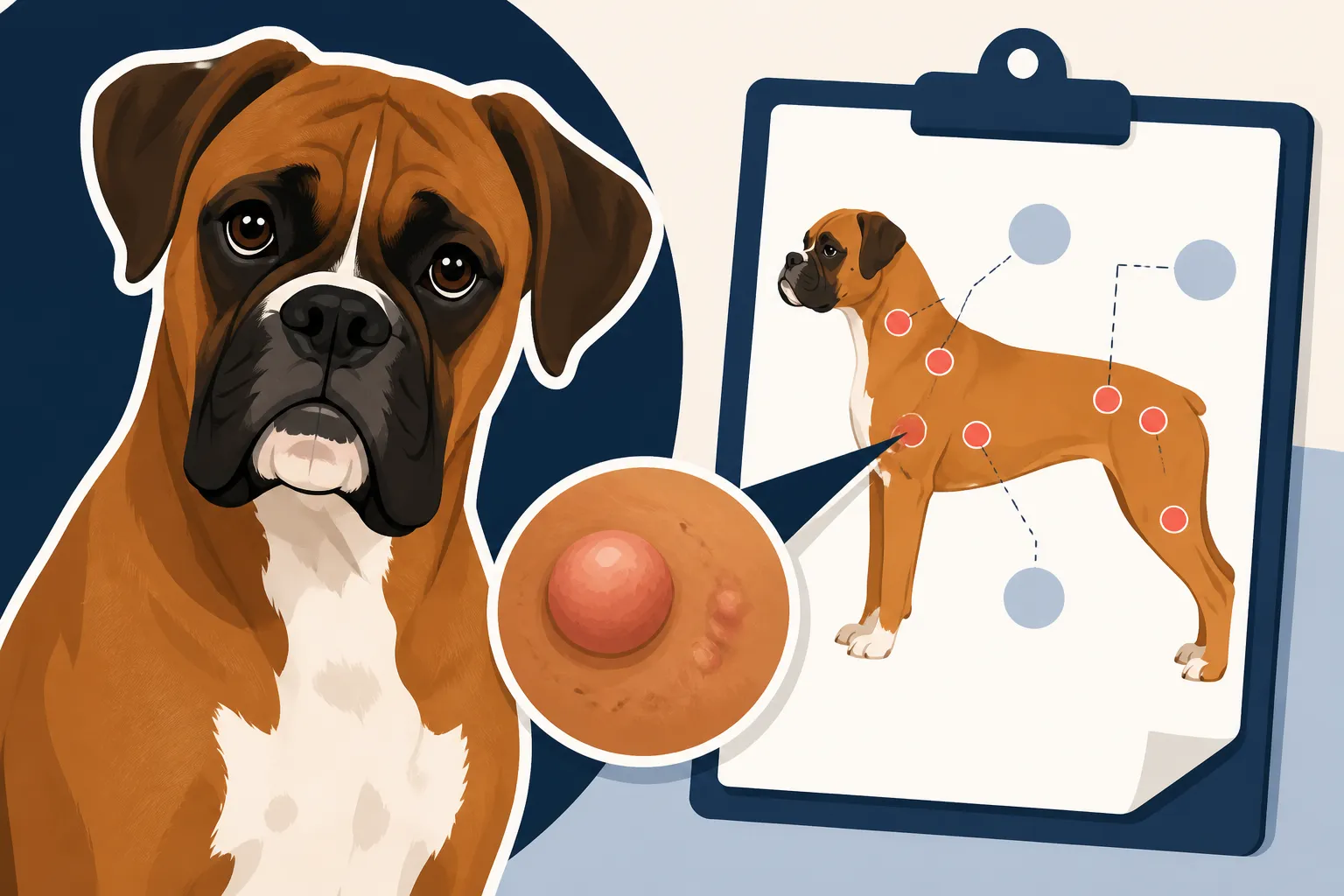
Mapping a Boxer’s Lumps on Paper
Finding a new lump or bump on your beloved Boxer can send a chill down your spine, instantly sparking worry about what it might be. It’s a common and anxiety-inducing part of Boxer ownership, given their unfortunate predisposition to various growths. This guide is here to walk you through the proactive, systematic approach of mapping your Boxer’s lumps on paper, turning that fear into an actionable plan for vigilance and early intervention.
The Uneasy Reality of Boxer Lumps
As Boxer owners, we learn quickly that lumps and bumps are just part of the journey. Our sweet, goofy companions seem to sprout new ones overnight, and every time you run your hand over their velvety coat, there's that moment of dread: "What's this?" It's a heavy burden, knowing that Boxers are so prone to mast cell tumors, lipomas, histiocytomas, and a host of other skin conditions, both benign and malignant. The sheer frequency can make it easy to dismiss a new growth, or worse, to become overwhelmed and unsure of how to keep track. But ignoring them or simply hoping for the best isn't an option when it comes to a breed where early detection can genuinely make a life-or-death difference.
We often feel like we're constantly on high alert, our hands perpetually searching, our minds always cataloging. It's exhausting, but it's also a testament to our love and dedication. The reality is, not every lump is sinister. Many are benign fatty tumors (lipomas) or even temporary viral warts, especially on young Boxers. However, the malignant ones, particularly mast cell tumors, can look indistinguishable from harmless ones to the untrained eye. This is precisely why a structured, systematic approach to monitoring is so vital. It removes some of the guesswork and gives you a clear record to present to your veterinarian, making their job of diagnosis much easier. This isn't just about finding a lump; it's about understanding each lump's story from the moment it appears.
Why a "Lump Map" Becomes Your Secret Weapon
Imagine trying to explain to your vet, "Oh, there's this new bump, I think it's on his left side, near his shoulder, or maybe his rib cage? It feels about the same as that other one he had last year." It's vague, it's unhelpful, and it certainly doesn't instill confidence. This is where a Boxer lump map comes into its own as your most powerful tool. It transforms anecdotal observations into concrete, documented evidence. A detailed map provides a visual and written history for every single growth your Boxer develops. It means you can confidently tell your vet, "This lump appeared on July 10th, 2023, on his right flank, measuring 1.5 cm. It hasn't changed much until this week, now it feels softer and has grown to 2 cm." That kind of information is invaluable.
The map isn't just for your vet; it's for you, too. It alleviates some of that constant low-level anxiety because you have a system. You know exactly what you've found, where it is, and what its baseline characteristics are. This empowers you to differentiate new lumps from old, to track changes, and to know when a lump genuinely warrants immediate veterinary attention versus watchful waiting. Without such a system, it's easy for lumps to blend into the background, or for a significant change to go unnoticed because you don't have a clear point of reference. Think of it as a detailed health log, specifically tailored to the unique skin and tumor challenges our Boxers face. It turns a reactive "oh no, a lump!" into a proactive "I've documented this lump, and here's its history."
Early Detection: More Than Just a Hope
For many types of cancer in Boxers, particularly mast cell tumors, early detection is absolutely critical. These tumors can be notoriously aggressive and their behavior can be unpredictable. A small, seemingly innocuous lump can harbor a high-grade tumor that spreads quickly if not addressed promptly. When your Boxer's The Lumps a Boxer Owner Has to Check For appear, knowing exactly when it first emerged and how it has progressed gives your vet a crucial advantage. It allows for timely diagnostics, like a fine needle aspirate (FNA) or biopsy, before the tumor has a chance to invade deeper tissues or metastasize to other parts of the body.
The difference in prognosis between an early-stage, low-grade mast cell tumor removed with wide margins and a late-stage, high-grade tumor that has already spread can be profound. The cost and complexity of treatment also escalate dramatically with advanced disease. By routinely mapping, you're giving your Boxer the best possible chance at a positive outcome. It's not just about prolonging life; it's about preserving their quality of life, minimizing the need for extensive surgeries or grueling chemotherapy down the line. It's a preventative measure wrapped in a detective's log, giving you the power to act swiftly and decisively when it matters most. For more information on Why Cancer Kills More Boxers Than Anything Else, early detection is paramount.
Building Your Boxer's Comprehensive Lump Map
Creating a lump map isn't complicated, but it does require consistency and a few basic tools. Don't worry, you don't need to be an artist or have a veterinary degree. The goal is clarity and accuracy, not a masterpiece. This isn't just a mental exercise; it’s a tangible document that becomes a vital part of your Boxer's health record. It should be something easily accessible, that you can update regularly and grab immediately if you need to head to the vet. Some people prefer a physical binder, while others opt for digital notes, but the principle is the same: a clear, organized record.
The Tools You'll Need
Gathering a few simple items will make your mapping process much easier and more effective. You're essentially setting up a mini-command center for your Boxer's skin health.
- A Dedicated Notebook or Journal: This is your primary record keeper. Choose one that's sturdy and large enough for detailed notes. You can find excellent options on Amazon, perhaps even one with graph paper for easier sketching. This will be where you record dates, observations, and decisions.
- Pens/Markers: Different colored pens can be helpful for highlighting changes or marking specific types of lumps if you have many. Pet-safe markers (non-toxic, washable) can also be used very carefully to mark the fur around a lump for a quick visual reference if you struggle to relocate it, but be mindful of your Boxer's skin and coat.
- Body Outline Diagram: This is perhaps the most crucial visual tool. You can print several copies of a blank dog outline (side views, top view, bottom view) from the internet. Many vet clinics even have generic dog body charts you could ask for. Having separate pages for different views allows for precise marking.
- Measuring Tape/Ruler: A soft, flexible measuring tape (like a tailor's tape) or a small ruler is essential for tracking size. Consistency is key here. You want to measure in the same way each time.
- Camera (Smartphone is fine): Take clear, well-lit photos of each lump, especially as they change. Include a ruler next to the lump in the photo for scale if possible. Date-stamped photos are incredibly powerful evidence.
- Calendar/Planner: To schedule your weekly lump checks and follow-up vet appointments. Consistency is what makes this system work.
- Flashlight: Sometimes, a good light source can help you see subtle changes or smaller lumps that might be hidden by fur.
You might even consider a specific journal for pet health tracking, available from places like Chewy, which often include sections for medication, vet visits, and general observations, making it easy to incorporate your lump map into a broader health record.
Step-by-Step Mapping Protocol
Now for the practical application. Making this a routine is vital. I recommend setting aside dedicated time, perhaps once a week, for a thorough "lump check." This is also a great bonding opportunity with your Boxer, making it less of a chore and more of a loving ritual.
- Establish a Routine: Pick a consistent day and time each week for your Weekly Lump Checks on a Boxer. Sunday evening, while you're relaxing, can be a great time. Make it calm and positive, perhaps with treats or gentle praise. Your Boxer should see this as a pleasant experience, not something to fear. A favorite high-value treat from Ollie's range might be a good distraction!
- Start with a Full Body Palpation: Begin by systematically running your hands over every inch of your Boxer's body. Start at the nose, move over the head, down the neck, chest, belly, back, legs, and even between their toes and under their tail. Feel for anything new, or any changes to existing bumps. Pay close attention to areas where skin folds, like around the jowls or armpits.
- Identify and Isolate Each Lump: When you find a lump, take a moment to really feel it. Is it firm or soft? Moveable or fixed? Does it seem attached to the skin or deeper tissue? Is it painful to your Boxer when you touch it?
- Mark on the Diagram: On your body outline diagram, use a pen to mark the exact location of the lump. Be as precise as possible. You can number each lump on the diagram and then correspond that number to a detailed entry in your notebook. If you have many, drawing a small circle and writing the number inside works well.
- Document in Your Journal: For each numbered lump, create a dedicated entry in your notebook. Include:
- Date Found: The first time you noticed it.
- Location: Be specific (e.g., "right flank, 5 cm behind last rib," "inner left thigh, midway down").
- Size: Measure length, width, and height (if applicable). Record in centimeters or millimeters. "1.5 cm x 1 cm x 0.5 cm."
- Texture/Consistency: Describe how it feels (e.g., "soft and squishy," "firm and rubbery," "hard like a marble").
- Mobility: Does it move freely under the skin, or is it fixed to underlying tissue?
- Appearance: Is the skin over it red, ulcerated, or normal? Is it raised or flat?
- Color: Is it skin-colored, pink, black, or red?
- Pain/Discomfort: Does your Boxer react when you touch it?
- Photos: Note if you took a photo and where it's stored.
- Measure and Re-measure: Use your flexible measuring tape to get accurate dimensions. For consistency, always measure the longest and widest points.
- Regular Updates: Each week, during your lump check, re-examine every documented lump. Note any changes in size, shape, texture, or skin appearance. Record these updates in your journal under the lump's specific entry. If there’s no change, write "no change noted" with the date. This proves you're still monitoring it.
What to Document: Details That Matter
The devil is truly in the details when it comes to lump mapping. The more specific and consistent you are in your documentation, the better equipped you'll be to identify concerning changes and communicate effectively with your veterinarian. This meticulous record-keeping is what elevates a simple observation to a powerful diagnostic aid. Don't skimp on the descriptive language; imagine trying to describe the lump to someone who can't see it.
Key Characteristics to Note
When you find a new lump or are re-evaluating an existing one, here are the crucial details to write down. These characteristics help both you and your vet differentiate between various types of growths, from harmless fatty deposits to more aggressive tumors.
- Date of Discovery: This is your baseline. Knowing exactly when you first noticed a lump is paramount for tracking its progression. "Found on 03/15/2024."
- Exact Location: As mentioned, precision is key. Use anatomical landmarks. Instead of "on the leg," try "on the outside of the left rear leg, 5 cm above the hock." Referring to your body diagram helps ensure consistency.
- Size (Length x Width x Height/Depth): Use a flexible measuring tape. For small, round lumps, diameter is fine. For irregular ones, get the longest and widest points. Try to also gauge depth if possible. This is perhaps the single most important objective metric. "Size: 2.1 cm x 1.8 cm, approximately 0.5 cm deep."
- Shape: Is it perfectly round, oval, irregular, flat, dome-shaped? "Roughly oval with a raised dome."
- Consistency/Texture: How does it feel?
- Soft/Squishy: Like a water balloon or a soft marshmallow. Often indicative of a lipoma (fatty tumor) or cyst.
- Firm/Rubbery: Like a pencil eraser or a hard rubber ball. Can be benign or malignant.
- Hard/Bony: Immovable and rock-hard. Could be bone, scar tissue, or a calcified mass.
- Fluctuant: Fluid-filled, like a soft blister. Often a cyst or abscess.
- "Feels firm but slightly compressible."
- Mobility: Does it move freely under the skin when you try to shift it, or is it fixed to deeper tissue? A highly mobile lump is often less concerning than one firmly attached. "Moves freely under the skin." vs. "Firmly attached to muscle layer, not movable."
- Skin Overlying the Lump: Is the skin normal, red, inflamed, hairless, ulcerated, or crusty? "Skin is normal color, no hair loss." vs. "Skin is reddened, slightly flaky, with a small central ulceration." Changes in the overlying skin can be a strong indicator of a mast cell tumor, which can sometimes "flare up" (Darier's sign).
- Pain or Discomfort: Does your Boxer react when you touch, palpate, or measure the lump? Wincing, pulling away, or vocalizing suggests pain. "No apparent pain on palpation." vs. "Flinches when touched."
- Temperature: Does the lump feel warmer than the surrounding skin? This could indicate inflammation or infection. "No noticeable warmth."
Having these precise notes allows you to track patterns and Why Boxer Mast Cell Tumors Change Size, providing crucial context for your vet.
Tracking Changes Over Time
The real power of your lump map comes from consistent tracking. A single snapshot of a lump is less informative than a detailed timeline of its behavior. Regularly scheduled checks (weekly is ideal) allow you to observe any evolution, no matter how subtle.
Create a section for each lump where you can add dated entries documenting changes.
- Growth or Shrinkage: The most obvious change. If a lump grows rapidly, it’s a red flag. Some benign lumps, like histiocytomas on young Boxers, might grow quickly and then resolve on their own. Histiocytomas on a Young Boxer are an example of this. You need dated measurements to confirm.
- Changes in Texture or Firmness: A lump that becomes harder or softer might indicate a change in its nature.
- Changes in Skin Appearance: Increased redness, ulceration, hair loss, or scaling over a lump are significant and should be noted immediately. These can sometimes indicate the development of a more aggressive tumor, or simply an irritated benign one.
- Development of Pain/Discomfort: If a previously non-painful lump suddenly becomes sensitive, it warrants attention.
- Color Changes: Any change in the color of the lump itself or the overlying skin is important.
- Associated Symptoms: Is your Boxer now lethargic, losing appetite, or showing any other general signs of illness that could be related to a growing or spreading tumor?
Keep a record of any veterinary intervention as well: "04/01/2024: Vet visit, FNA performed. Results pending. Lump measured 2.3 cm x 2.0 cm." This comprehensive history is invaluable. If you're ever concerned about a lump and wondering if Whether a Boxer Wart Needs Removing, your detailed map will help you and your vet make that decision.
When Your Map Tells You It's Time for the Vet
Your lump map isn't just a record; it's a decision-making tool. Its primary purpose is to help you recognize when a lump requires professional veterinary attention. While we can monitor and document, only a vet can properly diagnose and recommend a course of action. Trusting your gut feeling as a Boxer owner is important, but backing it up with hard data from your map is even better.
Interpreting Your Findings
Certain changes and characteristics of a lump should prompt a call to your vet without delay. It’s always better to be safe than sorry, especially with a breed so prone to aggressive cancers. Don't second-guess yourself if your map suggests a worrying trend.
- Rapid Growth: If a lump doubles in size in a matter of weeks, or even days, that's a significant red flag. Fast-growing lumps are often more concerning.
- Changes in Texture or Firmness: A lump that suddenly becomes much harder, or irregular in shape, needs immediate evaluation.
- Fixed to Underlying Tissue: If a lump that was once mobile becomes fixed, or a new lump is immediately non-mobile, it can indicate a more invasive growth.
- Ulceration, Redness, or Bleeding: Any breakdown of the skin over the lump, or signs of inflammation, should be investigated promptly. These can be classic signs of an angry mast cell tumor.
- Pain or Discomfort: If touching the lump elicits pain from your Boxer, it needs attention. It could be an infection, an abscess, or a rapidly growing tumor.
- Recurrence: If a lump was previously removed and now reappears in the same spot or nearby, that's definitely a reason to see the vet. Whether a Boxer Mast Cell Tumor Comes Back is a common concern.
- General Ill Health: If your Boxer is also showing other signs of illness (lethargy, loss of appetite, weight loss) in conjunction with a lump, seek veterinary care immediately.
Even if a lump doesn't exhibit these alarming signs, if it simply worries you, trust your instincts. You know your Boxer best. It's never wrong to have a new lump, or one you're unsure about, checked by a professional. Don't assume that because your Boxer is getting older, every new lump is just an old-age growth. While Telling a Boxer Fatty Lump From a Tumor can be tough without diagnostics, your map helps narrow it down.
Preparing for the Vet Visit
When you have a lump to show the vet, your meticulously kept lump map becomes your greatest asset. It allows for a much more efficient and informed consultation. Instead of guessing, you'll be presenting facts and a timeline.
- Bring Your Map: Take your entire journal or notebook, including the body diagrams and photos. This visual and written history is invaluable for the veterinarian. It provides context they wouldn't get from a quick exam alone.
- Highlight the Key Concerns: Before you go, review your notes and be ready to articulate why this particular lump is concerning. Is it the rapid growth? The change in color? The fact that it's new and you want a baseline diagnosis?
- Be Ready for Diagnostics: Your vet will likely recommend a fine needle aspirate (FNA) as a first step. This involves using a small needle to collect cells from the lump for microscopic examination. It's a quick procedure, often done right in the exam room, and can often distinguish between benign and malignant growths. Be prepared for the possibility that an FNA might not be definitive, and a surgical biopsy might be recommended. Needle Biopsy on a Boxer Lump is usually the first step.
- Ask Questions: Don't hesitate to ask your vet what they suspect, what the next steps are, and what the potential prognoses might be. Understanding the diagnosis and treatment plan is crucial for you as an owner.
The investment of time you put into mapping your Boxer's lumps is an investment in their health and longevity. It’s a proactive measure that empowers you, the owner, to be an even stronger advocate for your beloved companion.
| Lump ID | Date Found | Location (Specific) | Size (LxWxH cm) | Texture/Consistency | Mobility | Overlying Skin | Pain? | Vet Visit Date | Diagnosis (if any) |
|---|---|---|---|---|---|---|---|---|---|
| 1 | 2023-08-10 | R flank, behind last rib | 1.5 x 1.2 x 0.5 | Soft, squishy | Mobile | Normal | No | 2023-08-25 | Lipoma (FNA confirmed) |
| 2 | 2024-01-15 | L rear thigh, outer side | 0.8 dia. x 0.3 | Firm, rubbery | Mobile | Normal | No | 2024-02-01 | Histiocytoma (resolved by 04/2024) |
| 3 | 2024-05-03 | L armpit, deeper | 2.0 x 1.5 x 1.0 | Firm, fixed | Fixed | Normal | Yes (slight) | 2024-05-10 | Awaiting FNA results |
| 4 | 2024-06-20 | R ear base, under fur | 0.7 dia. x 0.2 | Rough, scabby | Fixed | Ulcerated | No | 2024-06-25 | Suspect Mast Cell Tumor |
Taking the time to systematically map your Boxer's lumps on paper is one of the most practical and loving things you can do for their long-term health. It transforms a frightening discovery into an organized, trackable health record, giving you and your vet the best possible chance to catch and address any issues early. Stay diligent, stay proactive, and keep those records updated – your Boxer is counting on you.
Disclaimer
This article is for general informational purposes only and does not constitute professional advice. Laws, prices and regulations vary by location and change over time. Consult a qualified professional for guidance on your specific situation.