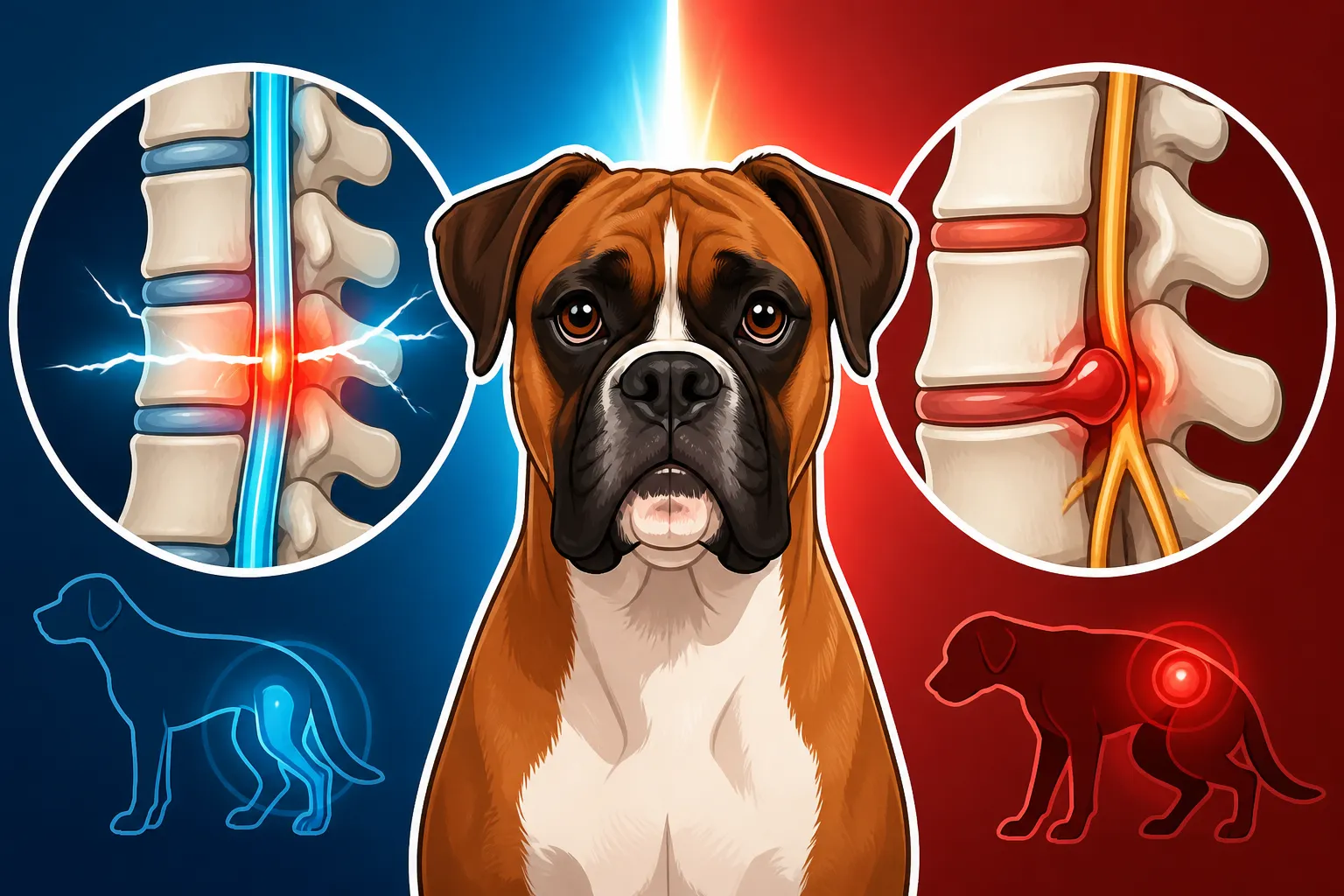
Telling Myelopathy From a Boxer Disc Injury
Few things are more heartbreaking than watching your beloved Boxer start to struggle with their hind legs. The confusion, the wobble, the sudden difficulty with stairs or even just getting up – it’s a terrifying experience that immediately sends most Boxer parents down a rabbit hole of worry. Is it just old age? Is it something more serious? Specifically, many of us find ourselves grappling with the possibility of two very different, yet sometimes visually similar, conditions: degenerative myelopathy (DM) or a disc injury. This guide is here to walk you through the nuances, helping you understand the critical differences so you can advocate for the right diagnosis and care for your furry family member.
Understanding Degenerative Myelopathy in Boxers
Degenerative Myelopathy, or DM, is a condition that strikes fear into the hearts of many Boxer owners. It's a progressive, incurable neurological disease that slowly robs a dog of its ability to walk. What makes it particularly insidious is its often subtle and painless onset, leading many to initially dismiss the signs as normal aging.
The Insidious Onset of DM
DM typically begins to manifest in older Boxers, usually around 8 years of age or more, though it can appear earlier. The first signs are incredibly subtle, which can be frustrating because you know something is wrong, but it’s hard to pinpoint. You might notice your Boxer’s back paws scuffing the ground more than usual, perhaps the nails on one or both back feet are wearing down unevenly because they aren't lifting their feet properly. Maybe you see a slight wobble in their hindquarters when they stand up, or they seem a little clumsy when making a sharp turn. It’s not dramatic, it’s not sudden, and most importantly, it’s generally not painful.
Imagine a Sunday afternoon, you’re playing fetch in the yard, and your senior Boxer, who used to glide across the grass, now seems to stumble just a tiny bit on a turn. Or perhaps you're on your daily walk, and you notice a slight drag in one of their back feet, almost imperceptible to anyone but you, the observant parent. These fleeting moments, easily dismissed as a misstep or a sign of an "old dog," are often the very first whispers of DM. This slow, painless progression is a hallmark of the disease, and it’s why it’s so often mistaken for simple age-related stiffness or arthritis. If your Boxer is past eight, it’s wise to be extra vigilant, as this is when you start Caring for a Boxer Past Eight becomes even more critical.
Classic DM Symptoms and Progression
As DM progresses, the symptoms become more pronounced, though still, crucially, without pain. The hind limb weakness becomes more obvious, leading to a distinctive wobbly or drunken gait, medically known as ataxia. Your Boxer might start crossing their back legs when walking, especially on uneven surfaces, or struggle to maintain balance. Getting up from a lying position becomes a monumental effort, and they might need help to push themselves up. They might even start to A Boxer That Drags a Back Foot more consistently, leading to visible wear on their nails.
The progression of DM can vary, but it's typically a steady decline. What starts as mild weakness can advance to significant difficulty walking, then to partial paralysis, and eventually full paralysis of the hindquarters. It's a heartbreaking journey for owners to witness. Because the disease affects the spinal cord’s ability to send messages to the hind legs, you'll see a loss of proprioception – the awareness of where their limbs are in space. They might stand with their paws knuckled over and not even realize it, or struggle to correct them. While the physical decline is profound, it's vital to remember that Boxers with DM usually remain bright, alert, and engaged with their families. This painful reality often makes owners ask, How Fast Boxer Myelopathy Progresses and what can be done to slow it down. It’s also important to confirm that DM is generally not painful, leading to the question Whether Boxer Myelopathy Is Painful, which is a key differentiator from disc injuries.
Recognizing a Boxer Disc Injury
In stark contrast to the slow, painless progression of degenerative myelopathy, a disc injury in a Boxer is often characterized by sudden onset and significant pain. This is a crucial distinction that can help guide your initial assessment and subsequent veterinary care.
The Sudden, Painful Reality of a Disc Problem
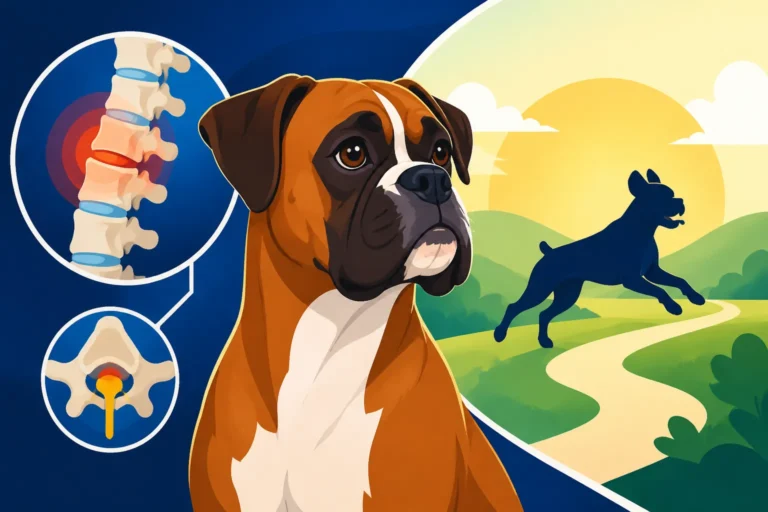
A disc injury, often referred to as intervertebral disc disease (IVDD) when chronic, or a slipped/herniated disc when acute, occurs when one of the cushion-like discs between the vertebrae in the spine either bulges or ruptures. When this happens, the disc material presses on the delicate spinal cord and nerves, causing inflammation, pain, and neurological deficits. Unlike DM, a disc injury can happen suddenly, often after a seemingly innocuous activity.
Picture this: your high-energy Boxer is mid-zoomie in the living room, makes a sharp turn, jumps off the couch, or even just missteps while playing. Suddenly, they yelp loudly, stop playing, and might even collapse or refuse to move their back legs. They might stand hunched, shivering, or guard their back fiercely, crying out if you attempt to touch them. This acute, excruciating pain is the most telling sign of a disc issue. Sometimes, it might not be a sudden yelp but a gradual onset of severe back pain over a few hours, leading to reluctance to move, eat, or even lift their head. It's a very different picture from the often-dismissed clumsiness of early DM.
Key Indicators of Disc Pain and Neurological Deficits
When a Boxer experiences a disc injury, the signs of pain are almost always undeniable. Beyond the yelping or crying, you might observe a hunched back posture, tense abdominal muscles, muscle spasms along the spine, and a general reluctance to move or be handled. They might refuse to jump, climb stairs, or even walk to their food bowl. They could shiver uncontrollably, not from cold, but from the intensity of the pain. If the disc injury is severe, it can lead to immediate neurological deficits, which can range from mild weakness (paresis) to complete paralysis (plegia).
The neurological signs can be unilateral (affecting one side more than the other) or bilateral, depending on where the disc has herniated and which nerves are compressed. You might see knuckling over of the paws, similar to DM, but here it's coupled with severe pain and often a more acute onset. In some cases, a Boxer might lose bladder and bowel control due to the nerve damage. The rapid progression from normal function to severe pain and loss of mobility is a strong indicator of a disc injury rather than DM. This distinct combination of severe pain and neurological changes sets it apart. It’s also crucial to distinguish this from other orthopedic issues like Boxer Hip Dysplasia and Spondylosis, which might cause hind leg weakness but generally presents differently.
Diagnostic Approaches and Treatment Differences
When your Boxer starts exhibiting hindquarter weakness, getting an accurate diagnosis is paramount. The diagnostic journey for degenerative myelopathy and disc injuries, while sharing some initial steps, quickly diverges due to their fundamental differences.
The Vet's Examination and Initial Tests
Your veterinarian will start with a thorough physical and neurological examination. This is where their trained eye will look for those tell-tale signs. They'll assess your Boxer's gait, reflexes, proprioception (their awareness of where their limbs are in space), and their response to pain. For instance, they'll check for "conscious proprioception" by flipping your Boxer's paw under; a healthy dog will immediately correct it, while a dog with neurological issues might be slow to react or not react at all. Crucially, they’ll be evaluating the presence and degree of pain – a primary indicator that separates a disc injury from DM.
Initial tests often include X-rays of the spine. While X-rays can be helpful in ruling out other conditions like fractures, tumors, or severe arthritis, and might show signs of Spondylosis on a Boxer's X-Ray (bone spurs along the spine often associated with aging), they typically cannot definitively diagnose either a herniated disc or DM. Disc material itself is soft tissue and doesn't show up clearly on standard X-rays. For DM, X-rays are more about excluding other potential causes of the symptoms. For many families, the cost of these advanced diagnostics can be daunting. This is where pet insurance, like a comprehensive policy from Healthy Paws, can really make a difference, helping to cover the often significant expenses involved in getting an accurate diagnosis.
Differentiating Through Clinical Signs and Advanced Diagnostics
The real diagnostic differentiation comes with advanced imaging and the cumulative clinical picture. If a disc injury is suspected, your vet will likely recommend an MRI or CT scan. These specialized imaging techniques provide detailed cross-sectional views of the spinal cord, allowing the veterinary neurologist to visualize the exact location and severity of a disc herniation and the compression it's causing on the spinal cord. This is the gold standard for diagnosing disc disease and planning appropriate treatment, whether it's medical management or surgery.
For degenerative myelopathy, the diagnostic process is often one of exclusion. Since there's no definitive imaging test that confirms DM, an MRI or CT scan is typically performed to rule out all other possible causes of spinal cord compression or neurological dysfunction, such as tumors, cysts, or severe disc disease. If all other treatable conditions are ruled out, and the clinical signs – particularly the progressive, non-painful hindquarter weakness – are consistent with DM, then a presumptive diagnosis of DM is made. There is a genetic test, The SOD1 Test for Boxer Myelopathy, which can identify Boxers at risk for DM, but it's important to understand that a positive test doesn't mean your dog has DM, only that they are genetically predisposed. It's a piece of the puzzle, not a definitive diagnosis of active disease.
Let's look at a quick comparison:
| Feature | Degenerative Myelopathy (DM) | Disc Injury (IVDD) |
|---|---|---|
| Onset | Gradual, insidious over weeks to months | Often sudden, acute |
| Pain | Generally painless, though secondary discomfort can occur | Usually significantly painful, often severe |
| Progression | Progressive, steadily worsening hindquarter weakness | Can be static, improve with rest, or acutely worsen |
| Symmetry | Typically bilateral (both sides), often starting subtly on one | Can be unilateral or bilateral |
| Primary Sign | Ataxia (wobbliness), proprioceptive deficits | Pain, reluctance to move, guarding, neurological deficits |
| Definitive Dx | Diagnosis of exclusion (ruling out other causes) | MRI or CT scan |
| Genetic Test | SOD1 test available (risk assessment, not definitive Dx) | Not genetically linked in this way |
Treatment pathways are vastly different. For a disc injury, depending on the severity, treatment can range from strict crate rest and anti-inflammatory medications to emergency spinal surgery. Speedy and accurate diagnosis is critical, as surgical intervention for severe disc herniations can be time-sensitive. For DM, since there is no cure, treatment focuses on supportive care to maintain quality of life. This includes physical therapy, exercise, nutritional support, and assistive devices like slings or Carts and Slings for a Boxer With Myelopathy as the disease progresses. Investing in a robust pet insurance plan, like one from Healthy Paws, early in your Boxer's life can provide immense peace of mind, knowing that whether it’s the long-term management of DM or the acute, costly intervention for a disc injury, you have support to focus on your Boxer's well-being without financial strain being the sole determining factor in care.
Disclaimer
The information provided in this article is for general informational purposes only and is not a substitute for professional veterinary advice. Always consult with a qualified veterinarian for any health concerns or before making any decisions related to your Boxer's medical care.