Whether a Boxer Comes Back When Called
Oh, the Boxer recall. If you've ever stood in a park, voice hoarse, watching your beloved Boxer prance away with a mischievous glint in their eye, seemingly oblivious to your desperate pleas, you know the frustration. It's a common struggle for many Boxer parents, leaving us wondering if our smart, goofy companions are truly hard of hearing or just incredibly selective. This guide is here to shed light on why getting a Boxer to reliably come back when called can be such a monumental task and, more importantly, to equip you with the understanding and strategies needed to build a rock-solid recall, transforming those off-leash adventures from nerve-wracking to wonderfully joyful.
Why Recall is So Challenging for Boxers
Let's be honest: Boxers are intelligent, loyal, and often want to please us. So why does "come" often translate to "zoom in the opposite direction" for them? It's not about malice; it's about their unique blend of characteristics, genetic predispositions, and a natural zest for life that makes them easily captivated by the world around them. Understanding these core traits is the first step in tackling the recall challenge.
The Boxer's "Selective Hearing"
It's a phenomenon many Boxer owners can attest to: indoors, your Boxer responds to every whisper; outdoors, in a stimulating environment, suddenly they're profoundly deaf. This isn't actual hearing loss, but rather a perfect storm of curiosity, independence, and a high reward threshold for environmental stimuli. To your Boxer, the scent of that squirrel five fields over, the rustle of leaves, or the distant bark of another dog can be far more intrinsically rewarding than whatever you might be offering.
This selective hearing comes from their alert nature. Boxers are highly aware of their surroundings, and while this makes them excellent watchdogs, it also means their attention can be easily hijacked. When they’re focused on something external, your voice often becomes background noise. We, as owners, need to learn how to compete with — and ultimately win against — these powerful distractions. It requires consistency, patience, and making yourself the most exciting thing in their world, even when a flock of pigeons takes flight.
High Prey Drive and Curiosity
Boxers were originally bred as working dogs, ancestors of hunting and bull-baiting dogs. While modern Boxers are far removed from those days, a flicker of that instinctual prey drive often remains. That twitching tail in the distance, the scampering rabbit, or even a blowing plastic bag can ignite their chase instinct. Once that switch is flipped, their focus narrows intensely on the "prey," and everything else, including your voice, fades into insignificance.
Their inherent curiosity only amplifies this. Boxers love to explore. Every new smell, every rustle in the bushes, every intriguing corner of the park is an invitation to investigate. This combination of a strong drive to chase and an insatiable curiosity means that an off-leash Boxer is constantly presented with highly engaging, self-rewarding activities that are hard for a human voice to beat. We need to acknowledge this powerful drive and work with it, not against it, to build a reliable recall. Think about it from their perspective: chasing that bird is a primal, exhilarating experience. Being called back for a piece of dry kibble? Not so much.
Delayed Maturity and Puppy Brain
One of the most endearing — and sometimes maddening — traits of the Boxer is their prolonged puppyhood. Many Boxer owners will tell you that their dogs don't truly "grow up" until they're two or even three years old. This means that even a two-year-old Boxer might still have the attention span and impulsive behavior of a much younger dog. The exuberance and boundless energy, coupled with a still-developing brain, can make consistent recall incredibly challenging. The Boxer Puppyhood That Lasts Three Years often describes this period perfectly.
During this extended adolescence, Boxers are still learning impulse control and refining their understanding of consequences. They might genuinely want to come back, but the immediate gratification of sniffing that interesting bush or playing with another dog often overrides the learned behavior. This isn't a sign of defiance, but rather a developmental stage. It means you need to approach recall training with extra patience, understanding that what might work for a quick-maturing breed at one year old may still be a work in progress for your Boxer at two. Don't get discouraged; persistence through these "teenage" years will pay off.
Building the Foundation: Early Training and Socialization
A reliable recall isn't just about yelling "Come!" louder or more often. It's built on a bedrock of trust, positive association, and consistent, clear communication. Laying this foundation early, ideally from puppyhood, is crucial, but it's never too late to start strengthening these core principles with an older Boxer.
Making Yourself More Exciting Than the Environment
This is perhaps the single most critical element of recall training for a Boxer. You need to be the bringer of all good things, the source of ultimate fun and reward. If coming back to you means the end of a good time, why would your Boxer choose that? Instead, make coming back to you the start of something even better. This isn't about being a performing clown every second, but about strategically making interactions with you incredibly positive and unpredictable.
When your Boxer is with you, engage them. Play quick games of tug, offer a sudden, super high-value treat, or launch into a brief, enthusiastic play session. Teach them that you are the hub of excitement. If your Boxer only experiences you as the person who clips on the leash and takes them home, or who only calls them when it's time to stop playing, they'll learn to associate your call with the end of fun. Vary your rewards and interactions, and always strive to be more interesting than that discarded chicken bone or distant jogger.
Positive Reinforcement and High-Value Rewards
Boxers respond incredibly well to positive reinforcement. They thrive on praise, affection, and, let's be honest, delicious treats. For recall, "high-value" isn't just a suggestion; it's a necessity. A piece of dry kibble might work in your quiet living room, but it stands no chance against a squirrel in the park. You need to pull out the big guns: cooked chicken, cheese, hot dogs, freeze-dried liver, or their absolute favorite store-bought soft training treats. Think about what makes your Boxer go absolutely wild, and save those items exclusively for recall practice.
| Reward Value | Examples for Boxers | When to Use |
|---|---|---|
| High-Value | Cooked chicken, cheese, hot dogs, freeze-dried liver, bully sticks | For recall in distracting environments, new places, emergency recalls |
| Medium-Value | Store-bought soft training treats, jerky, favorite toy | For routine recall practice in moderately distracting areas, maintaining focus |
| Low-Value | Kibble, plain biscuits, pats | For recall in very low-distraction environments (indoors), reinforcing known behaviors |
Always pair these high-value treats with enthusiastic verbal praise ("YES! GOOD COME!"). The goal is to create such a strong positive association with the "come" cue that your Boxer drops everything and races back to you, anticipating that amazing reward. The better the reward, the stronger the motivation to return. Never underestimate the power of a truly irresistible treat. This is where a little searching on Amazon for unique, high-quality training treats can pay off big time.
Starting in a Low-Distraction Environment
You wouldn't ask a child to solve advanced calculus before they've mastered addition, right? The same principle applies to Boxer recall. Begin in an environment where your Boxer is highly likely to succeed. Your fenced backyard, a quiet room in your house, or even an empty tennis court are ideal starting points. The fewer distractions, the easier it is for your Boxer to focus on you and understand what "come" means.
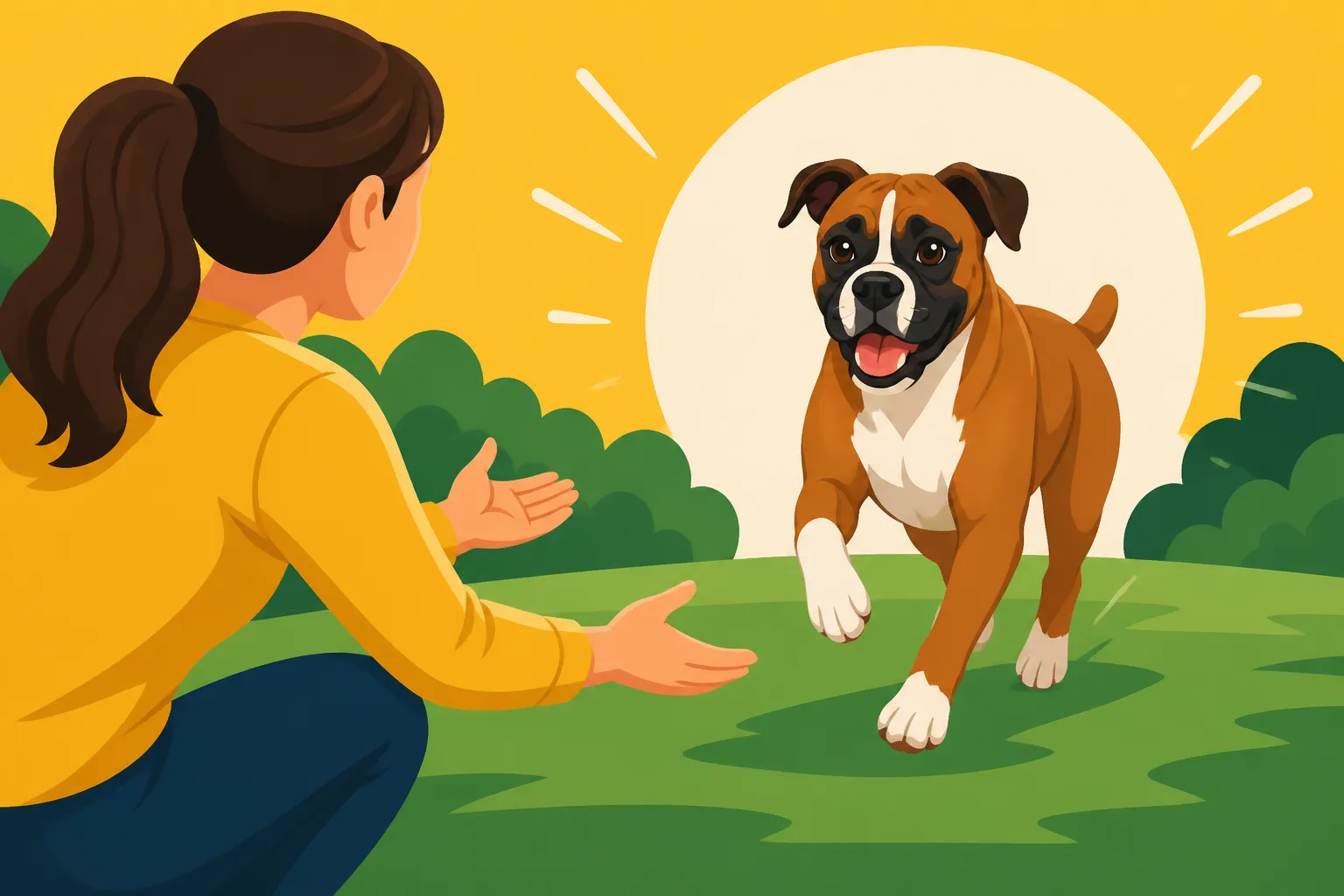
In these low-distraction settings, practice frequently and in short, fun bursts. Call your Boxer, reward them enthusiastically when they come, and then release them to go play again. The key is to make "come" a fun game, not a command that signals the end of freedom. As they consistently respond in these easy environments, you can gradually introduce mild distractions, building their reliability step-by-step. Remember, consistency is key, and every successful recall, even in a quiet space, reinforces the desired behavior. Think about taking a BAXTER & Bella online puppy program; they often emphasize these foundational steps in controlled settings before moving to the real world.
Overcoming Distractions: Training in Real-World Scenarios
Once your Boxer has a solid understanding of recall in low-distraction settings, it's time to slowly but surely introduce them to the complexities of the real world. This is where many owners get stuck, expecting their dog to perform perfectly in a busy park after only practicing in the backyard. Building a bomb-proof recall means systematically increasing the challenge.
Gradually Increasing Difficulty
The path to a reliable recall is a staircase, not a leap. After mastering recall indoors and in your backyard, start introducing very minor distractions. This might mean:
- Calling your Boxer when a family member is walking quietly nearby.
- Practicing in your front yard with mild street noise in the background.
- Moving to a slightly busier park at an off-peak time when there are fewer dogs or people.
The crucial part is to set your Boxer up for success. If they fail to come, you've probably increased the difficulty too quickly. Scale back to a level where they can confidently respond, reinforce heavily, and then try a smaller increment of distraction next time. Always keep an eye on your Boxer's body language; if they're too engrossed in sniffing or watching something, they're probably not ready for your recall cue at that moment. Gradually building up their tolerance to real-world stimuli ensures the "come" command remains powerful and consistent.
Proofing the Recall in Different Locations
Your Boxer might associate "come" with your backyard, but not necessarily with the local trail or the dog park. To truly generalize the behavior, you need to practice recall in a wide variety of locations. Each new environment presents its own unique set of sights, sounds, and smells, which can be highly distracting for a Boxer.
Take your Boxer to different parks, trails, open fields, and even urban settings (on a long line, of course). Start each new location as if it were a slightly more distracting version of your backyard. Do a few easy recalls, rewarding lavishly, before letting them explore more freely. This teaches your Boxer that "come" means the same thing, regardless of where they are or what amazing new smells they're encountering. This "proofing" process is essential for ensuring that your Boxer's recall isn't just location-dependent, but truly reliable anywhere.
Practicing Around Other Dogs and People
This is often the ultimate test for a Boxer's recall. Boxers are generally social dogs, and the allure of playing with another dog or greeting a friendly stranger can be incredibly strong. When practicing around other dogs or people, remember to keep your Boxer on a long line initially. This allows you to prevent them from practicing "running away" and gives you the control to enforce the recall. Long Line Work With a Young Boxer can be incredibly helpful here.
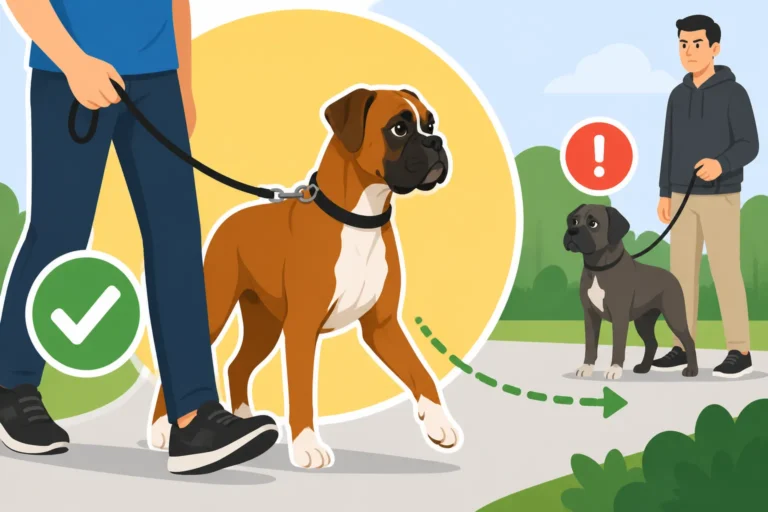
Start by practicing recall when the other dogs or people are at a significant distance, where your Boxer notices them but isn't overly fixated. As your Boxer consistently responds, slowly decrease the distance. If your Boxer is highly dog-reactive or becomes too overstimulated, you might need to seek guidance from a professional trainer to work through these specific challenges. The goal isn't to prevent them from socializing, but to teach them that you are still the priority, even when friends are around. This also ties into Boxer Reactivity Toward Strange Dogs if your Boxer tends to get overly excited or anxious.
Tools and Techniques to Aid Recall
Beyond consistent training and high-value rewards, several tools and specific techniques can significantly boost your Boxer's recall success, providing both safety and effective learning opportunities.
Using a Long Line for Safety and Practice
The long line is arguably the most indispensable tool for recall training, especially for a Boxer with a high prey drive and an adventurous spirit. A long line, usually 15 to 30 feet in length, allows your Boxer to explore and feel "off-leash" while still giving you control. This prevents them from practicing running off and ignoring your calls, which can quickly erode the reliability of your cue.
When using a long line, let your Boxer wander to the end of the line. Before they pull taut, give your recall cue ("Come!"). As you give the cue, gently reel in the line while backing away yourself to encourage movement towards you. When they reach you, reward them lavishly with a high-value treat and praise, then release them to play again. This teaches them that "come" means moving towards you, not just getting caught. It’s also a safety net, allowing you to stop them from darting into unsafe situations or chasing after a deer. You can find durable long lines on Amazon, perfect for a strong Boxer. Remember to attach the long line to a well-fitting harness, not a collar, to protect their neck if they hit the end suddenly. Harnesses That Hold a Pulling Boxer are great for this.
The "Emergency" Recall Word
For those truly high-stakes situations – a busy road, an aggressive dog approaching, or your Boxer fixated on something dangerous – you need an emergency recall. This should be a distinct word or sound, different from your everyday "come," and it should be reserved only for emergencies. The reason for a separate word is to prevent it from becoming desensitized through everyday use.
Choose a unique word or phrase (e.g., "Front!", "Here!", "Treat!") or even a sharp whistle. This emergency cue needs to be charged with the absolute highest-value rewards possible – think cooked steak, a lick of peanut butter, or a squeaky toy they adore. Practice it rarely, in controlled settings, always delivering the ultimate reward. The idea is that when they hear this word, they immediately associate it with an unparalleled reward and drop everything to get to you. Never use it unless it's a true emergency or a very rare practice session, to keep its power intact.
Whistles and Other Aids
Beyond verbal cues, a whistle can be a highly effective tool for recall, especially over longer distances or in noisy environments. A whistle produces a consistent sound that carries further than your voice and isn't influenced by your emotional state (which can unintentionally make your voice sound less appealing to your dog). Dog whistles can be particularly useful for Boxers who might tune out vocal commands.
Introduce the whistle in a low-distraction environment, pairing it immediately with your high-value reward every time you blow it. Do this several times without expecting a recall, just to build the positive association. Once they associate the whistle with treats, start blowing it and asking for your recall. Gradually, they will learn to associate the whistle with the "come" action. Other aids like clickers can also be used in conjunction with verbal cues to mark the exact moment of correct behavior, adding precision to your training. Rewards a Boxer Will Work Hard For can be a great resource for ideas.
Addressing Common Recall Mistakes
Even with the best intentions, owners often inadvertently make mistakes that undermine their Boxer's recall. Recognizing these common pitfalls is vital for course correction and building a more reliable response.
Calling Your Boxer for Unpleasant Things
Imagine being called by your boss only when it's time for extra work, a reprimand, or something you dislike. You'd likely start avoiding their calls, right? The same applies to your Boxer. If "come" consistently means the end of fun, getting locked up, or receiving a scolding, your Boxer will quickly learn to associate the command with negative outcomes and avoid it.
Never call your Boxer to do something they don't enjoy. For example, don't call them to go into their crate if they dislike it, or to have their nails trimmed, or to get a bath. Instead, go get them. Save the "come" command for times when something neutral or positive is about to happen. You want your Boxer to view "come" as an invitation to something great, not a trap. If you need to end playtime, simply walk over and gently leash them without using the recall cue. Over time, this helps maintain the positive association with the "come" command.
Chasing Your Boxer
It's an instinctive reaction when your Boxer darts away: you chase them. However, for a Boxer, being chased can quickly turn into a fun game of "keep away." They see you running after them, interpret it as playful pursuit, and enjoy the thrill of the chase, further reinforcing their desire to run away. This is a very common scenario with high-energy breeds like Boxers.
Instead of chasing, try to make yourself exciting and run away from your Boxer. Make silly noises, clap your hands, or drop to the ground and act goofy. Often, their curiosity will kick in, and they'll come to investigate what you're doing. This turns the dynamic around, making them pursue you, which is precisely what you want for recall. If they still don't come, use your long line to gently guide them back, always ensuring the return is positive. Avoid the chase, or you're inadvertently teaching them to run from you.
Getting Frustrated and Yelling
It's easy to get frustrated when your Boxer ignores you, especially when you're in a public place. However, yelling at your Boxer when they finally do come back (or when they refuse to) is incredibly counterproductive. A Boxer, being a sensitive breed, will associate your anger and loud voice with the act of coming to you. This creates fear and hesitation, making them less likely to come next time. Why a Boxer Shuts Down When You Get Loud explains this well.
When your Boxer eventually returns, even if it took a hundred calls and felt like an eternity, praise them enthusiastically and give them a treat. You're rewarding the act of returning, not the delay. Save any frustration for yourself and redirect it into planning better training sessions. Your tone of voice is a powerful tool; keep it light, happy, and inviting when you call your Boxer. A calm, consistent approach, even when tested, will yield far better results than an outburst of anger.
When to Seek Professional Help
Sometimes, despite your best efforts, recall remains a struggle. This is not a reflection of your failure as an owner or your Boxer's inability to learn. It simply means you might need a fresh perspective and tailored guidance from a qualified professional.
Recognizing When You're Stuck
There are clear signs that you might benefit from professional help with your Boxer's recall. If you find yourself consistently frustrated, seeing no progress despite diligent effort, or if your Boxer's recall is worsening in certain situations (e.g., around specific triggers like squirrels or other dogs), it's a good indicator. Similarly, if your Boxer has developed an aversion to coming when called, or if safety is becoming a serious concern during off-leash excursions, a professional can provide invaluable assistance.
Don't wait until the problem becomes entrenched or dangerous. Early intervention can prevent recall issues from escalating into more complex behavioral problems. A fresh pair of eyes from someone experienced with Boxer temperament and training can often identify subtle cues or training gaps that you might be missing, helping you to break through the plateau you've reached. It's an investment in your Boxer's safety and your peace of mind.
Benefits of a Professional Trainer
A professional dog trainer brings expertise, experience, and an objective perspective to your Boxer's recall challenges. They can:
- Assess your Boxer's individual motivations and challenges: Every Boxer is unique, and a trainer can identify what truly motivates your dog and what specific distractions are most powerful.
- Tailor a training plan: They can design a step-by-step recall program specifically for your Boxer and your lifestyle, addressing specific problem areas.
- Teach you advanced techniques: From specific long-line handling to body language cues and advanced reward strategies, trainers have a toolkit of techniques you might not know.
- Troubleshoot issues in real-time: Observing you and your Boxer interact allows them to correct mistakes in your timing, body language, or reward delivery immediately.
- Provide support and accountability: They can offer encouragement and keep you on track, helping you stay consistent even when things feel tough.
A good trainer acts as a coach, empowering you with the skills to train your Boxer effectively. They're not there to "fix" your dog, but to teach you how to communicate better with them.
Group Classes vs. Private Sessions
When considering professional help, you typically have two main options: group classes or private one-on-one sessions. Both have their merits, depending on your Boxer's needs and your budget. Group Class Against Private Work for a Boxer offers a deeper dive into this decision.
Group Classes:
- Pros: Cost-effective, provides a controlled environment for practicing around distractions (other dogs and people), offers socialization opportunities, and a sense of community with other dog owners.
- Cons: Less individualized attention, pace is set for the group, may not be suitable for Boxers who are overly reactive or easily overwhelmed by other dogs.
Private Sessions:
- Pros: Highly individualized attention, customized training plan, can address specific behavioral issues, flexible scheduling, can be done in your home or preferred training locations.
- Cons: More expensive than group classes, less opportunity for controlled socialization with other dogs during the session itself.
For severe recall issues or highly distracted Boxers, private sessions might be the best starting point to build a strong foundation. Once that foundation is solid, a group class can be excellent for proofing the recall in a more distracting, social setting. Many trainers offer a combination of both, starting private and transitioning to group as appropriate. Finding a trainer who understands the Boxer breed specifically can be a huge advantage.
Building a reliable recall with a Boxer is truly a journey, not a destination. It requires patience, consistency, and a deep understanding of their unique personality. But the rewards – the freedom to safely enjoy off-leash adventures and the unspoken trust it builds between you and your wonderful companion – are immeasurable.
Disclaimer
This article is for general informational purposes only and does not constitute professional advice. Laws, prices and regulations vary by location and change over time. Consult a qualified professional for guidance on your specific situation.